
You just checked your website’s rankings this morning on Google within your local market. You are securely standing in the number four position. Same as last month. And yet your traffic is down. The numbers don’t add up, and nobody seems to have a concrete answer for you.
This is one of the most disorienting things happening in the Canadian digital marketing scene right now. Business owners are doing everything right by the old SEO standards, holding solid positions in Google search results, but are watching their click-through rates fall quarter over quarter.
The explanation isn’t a glitch in your reporting or a Google penalty you’ve missed. It’s a structural shift in how search pages are set up and how people use them. The search experience has changed around your listing without your listing changing at all.
Here we will discuss why even if your Google rankings are alright, your clicks keep disappearing in 2026.
The search results page is not the same canvas it was three years ago. Here is what is pulling clicks away from even highly-ranked websites.
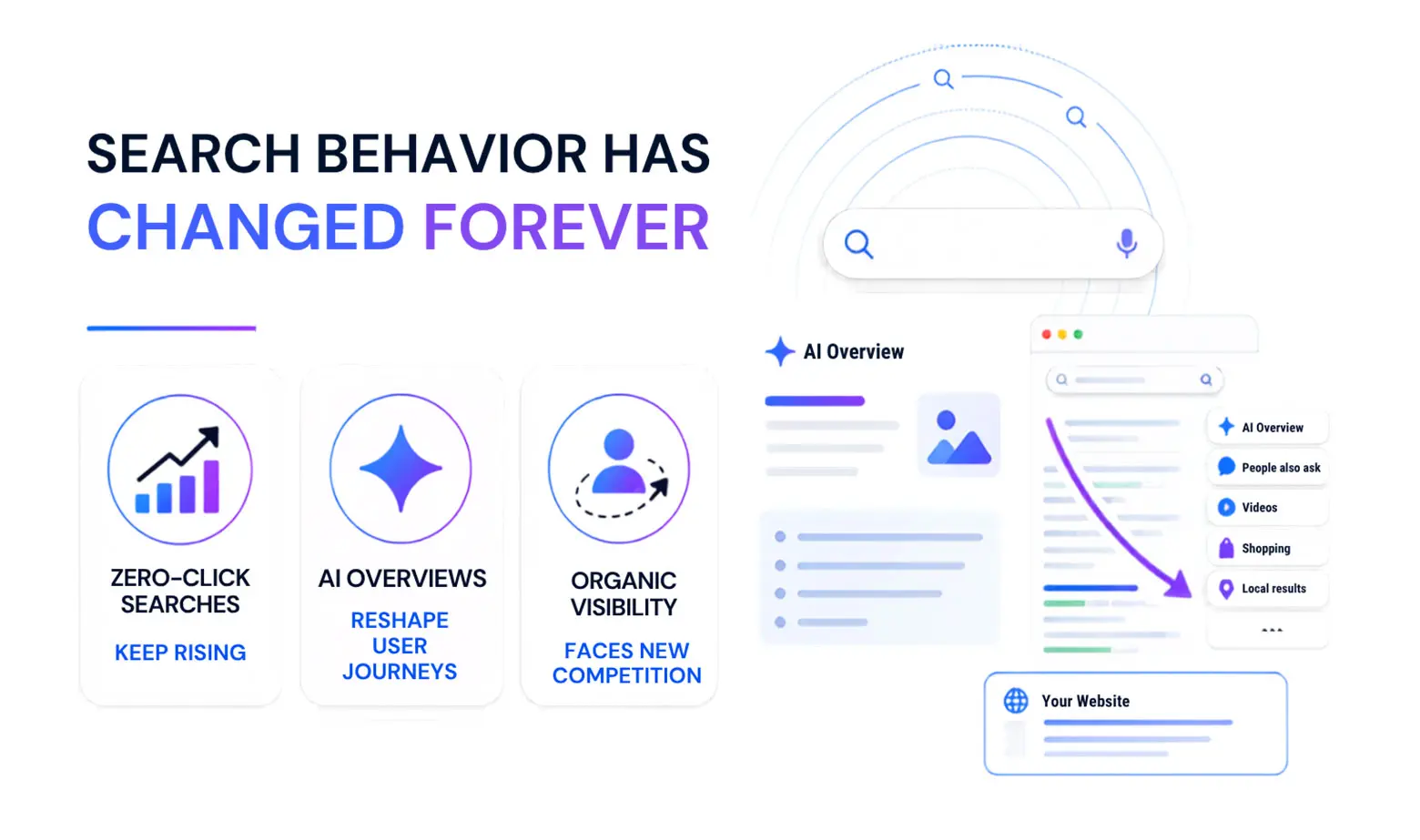
Google’s AI Overviews now appear above organic results for a significant portion of informational queries. When a user types a question, they often get a synthesized answer generated directly on the page. There is no need to click through to a website. The intent is satisfied right there.
Solid SEO services that earned you strong positions cannot protect your click-through rate when the answer is served before your listing is even seen. Positions one through ten have all taken impression-to-click losses on queries where AI Overviews appear. And this trend is accelerating as Google expands the feature to more query categories.
Zero-click searches—i.e., where a user finds what they need directly on the results page—have grown substantially. Featured snippets, knowledge panels, local map packs, and People Also Ask boxes all absorb the user’s attention before they consider clicking an organic result.
For businesses relying on informational content to drive traffic, this is a direct hit. The queries most affected tend to be exactly the kind that once produced reliable, steady traffic: definitions, how-to questions, quick comparisons and local lookups. If your content strategy was built on capturing those query types, the search engine results page itself is now your competition.
Organic listings used to feel prominent on the results page. Today, a typical results page includes a paid ad block, an AI Overview, a featured snippet, a People Also Ask accordion, and sometimes a map pack—all before a single organic blue link.
Your #4 position on a Google SERP may now appear below the fold on a laptop and well below the fold on mobile. Declining from a listing that hasn’t moved in rank isn’t a keyword problem. It’s a page layout problem. For instance, a business holding position three for a competitive term may now receive fewer clicks than a position one listing received two years ago.
Google’s Search Generative Experience is drawing from pages with clear, structured, authoritative content. Pages that provide thin overviews or surface-level summaries are being passed over in favour of content that resolves the user’s underlying question.
This has shifted what ‘quality’ means in practical terms. Content that was strong enough to rank two years ago may no longer be strong enough to earn inclusion in AI-generated summaries, which is now where the real visibility lives. Your SEO services need to account for this new quality threshold.
Users who are familiar with your brand will often bypass search entirely, going directly to your site or searching your name specifically. These lost clicks tend to show up most sharply in unbranded, informational queries—exactly the traffic that drove new visitor acquisition.
The audience most likely to click an unfamiliar organic listing is also the audience most likely to be satisfied by an AI-generated answer. Businesses are effectively losing the discovery layer of their traffic model, which is the part that fed the top of the funnel. This isn’t fixable with rank alone.
The ranking systems in 2026 are increasingly rewarding content that matches the full shape of a user’s intent—not just the words in their query.
A page optimized for a keyword but not genuinely built around the user’s underlying need is ranking but not converting, because the user senses immediately that the content isn’t quite answering their real question.
Analysis of 2026 SEO trends consistently shows that click-through rates are higher on listings whose titles and meta descriptions reflect a clear understanding of what the searcher actually wants to learn or do, not just what they typed.
The pattern of declining organic traffic is most visible in mid-funnel content like blog posts, comparison guides, and educational resources. These once served as the primary discovery mechanism for service businesses. Top-of-funnel queries are being absorbed by AI, and bottom-of-funnel queries are still converting through search. But the middle—the informational content that warmed up cold audiences—is losing click share across virtually every industry.
For instance, a well-written service guide that ranked on page one for 18 months may now drive a fraction of its former traffic. This is not because it ranked lower but because fewer people are clicking anything at all on that results page.
Ranking well is the minimum requirement. Here’s how effective SEO services adapt their strategy when the click itself is the problem.
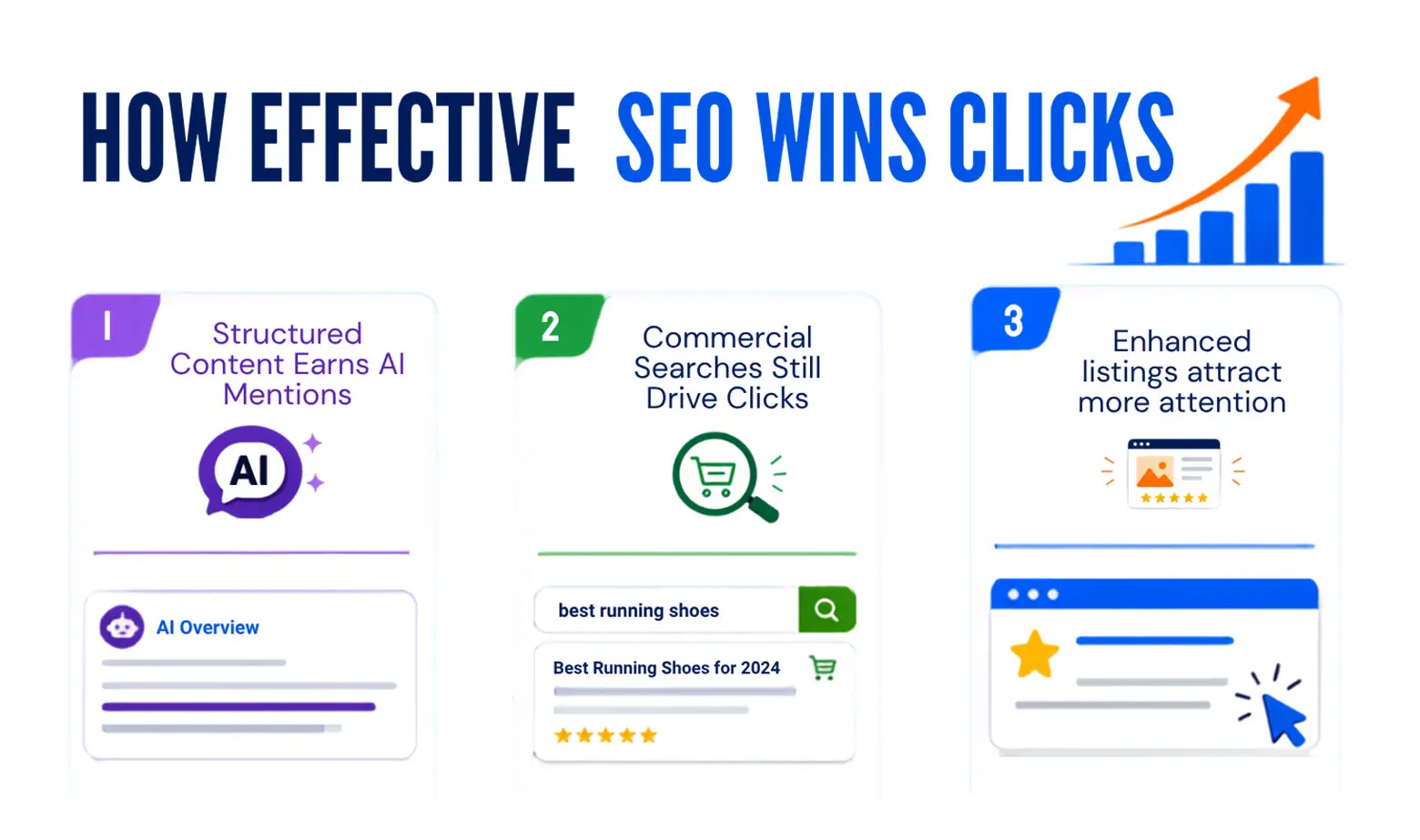
Rather than fighting AI Overviews, the most effective approach is to write for inclusion in them. Google’s AI draws from pages that provide simple, concise, well-structured answers near the top of the content. That means leading with the direct answer, following with supporting detail, and using impactful header structures that help Google extract and attribute your response.
Pages built this way are more likely to be cited as a source in the AI Overview, which still drives brand visibility, and some click traffic. SEO services that ignore this adaptation are leaving a significant visibility channel completely unaddressed.
Bottom-of-funnel queries—i.e., those searches with clear commercial or transactional intent—are still driving clicks to organic listings. Users searching for specific services, local providers, pricing comparisons, or direct solutions are not satisfied by an AI-generated paragraph. They need a real business, a real conversation, and a real decision.
Moving content investment toward these queries preserves the traffic that actually leads to clients and revenue. Bottom-funnel content tends to face less competition from AI-generated answers, meaning the click-through rates for well-crafted service pages remain considerably stronger than for informational blog content.
When your website does not appear in search results, it needs to earn the click in an environment that already contains paid ads, an AI Overview, a featured snippet, and a People Also Ask section.
Meta titles and descriptions that speak directly to the searcher’s specific situation—not the generic keyword—consistently outperform those optimized purely for keyword inclusion. And a website listing that reads like it was written by someone who understands the reader’s problem creates a trust signal that an AI-generated summary cannot replicate.
This is an area where careful, human writing still has a measurable advantage, and skilled SEO services account for that gap deliberately.
Structured data markup helps Google understand your content well enough to present it in richer formats on the search results page. Review stars, FAQ dropdowns, event details, and product information all expand your listing’s footprint there. A standard blue-link listing competes poorly against those more visually rich results.
Adding appropriate schema markup gives your pages the best chance of appearing in the enhanced formats that still attract attention. For instance, FAQ schema can pull your content directly into the People Also Ask section, which remains a visible and clicked feature even on pages dominated by AI Overviews.
If the rank is there but the traffic isn’t, these are the practical moves that shift the equation.
Google Search Console shows you both your average position and your click-through rate for each query. When those two numbers are misaligned—high position, low click rate—that’s your diagnostic signal. It tells you exactly which pages are losing clicks to zero-click features or AI Overviews.
Prioritize those pages for content updates that address the intent more directly, add structured data, and improve the meta copy. This is more precise and cost-effective than building new content from scratch, and it targets the pages where improvements will have the most immediate traffic impact.
Original research, proprietary data, direct client stories, first-hand expertise, and strong opinions backed by experience are all content types that AI systems struggle to reproduce convincingly. Google’s quality evaluators still reward E-E-A-T signals—experience, expertise, authoritativeness and trustworthiness—and those signals are strongest when the content reflects something genuinely human and specific.
Journalists, bloggers, and other publishers are more likely to link to content that contains original data or a clear point of view, which compounds your authority over time. Content without a distinct human perspective is increasingly indistinguishable from the AI-generated text already flooding search.
For businesses serving specific communities, local SEO signals like Google Business Profile completeness, consistent NAP data, local review volume and locally relevant content continue to drive meaningful click traffic. Local pack listings still pull clicks, also, especially on mobile.
Building a stronger branded search presence also reduces your dependency on unbranded informational queries, where the click-through rate erosion is sharpest. When people search your business name directly, they arrive with higher intent and convert at a higher rate. A well-managed local presence is one of the more resilient traffic strategies available right now.
Most SEO conversations focus on rankings and impressions. Click-through rate deserves its own attention and optimization process. To that end you can:
A page that holds its position but improves its click-through rate by even a few percentage points can recover a meaningful share of the traffic it has lost to the changing search landscape.
The click decline is not a signal that your SEO services have failed but that the game has changed and your strategy needs to catch up. Rankings still matter because they determine whether your listing appears at all. But appearing is only the first step now. The businesses that recover their traffic will be the ones who optimize for the click, not just the position and who build content worthy of the more demanding, AI-shaped search environment we’re all working in.
High rankings no longer guarantee clicks. AI Overviews, featured snippets and zero-click search features now satisfy many queries directly on the results page. Your listing appears, but users find their answer before they reach your link, which reduces click-through rates without affecting your position.
AI Overviews are AI-generated answer summaries that appear above organic results on Google. They pull from multiple sources and display a direct response to the searcher’s query. When present, they absorb a significant share of clicks that would otherwise go to the top organic listings on the page.
Zero-click search means a user completes their search without visiting any website. For small businesses, this typically hits informational and local queries hardest. It means content that once drove steady discovery traffic now generates impressions without sessions, which directly reduces the top-of-funnel audience your site was building.
Effective SEO services in 2026 focus on optimizing for AI Overview inclusion, improving meta copy to earn clicks in competitive environments, shifting investment toward bottom-funnel queries and building content that reflects genuine expertise. Rank optimization alone is no longer sufficient; click-through rate needs its own strategy.
Yes. Content that only provides surface-level answers is increasingly being absorbed by AI rather than clicked. Invest in original research, specific expertise, and content that addresses the full depth of the reader’s intent. Content with a clear human perspective and first-hand experience is harder for AI to replicate and more likely to earn both clicks and citations.
Click-through rate is the most critical companion metric to position tracking right now. Google Search Console shows you the CTR for each query on which your pages appear. A declining CTR on a stable ranking is a clear signal that zero-click features are intercepting your traffic, and it tells you exactly where to focus your optimization efforts.