
 Perplexity
 ChatGPT
 Claude
 Gemini
 Grok
Grok
Thousands of Toronto businesses have watched their web traffic quietly shrink over the past year. The culprit is not a Google penalty or a bad review. It’s an invisible filter built into every AI assistant that now answers your customers’ questions before they ever reach your website.
AI players like ChatGPT, Gemini, and Perplexity are not search engines; they’re recommendation engines. They don’t rank websites, but they do decide which businesses earn a mention and which disappear from the conversation entirely.
Most businesses do not even know they have been filtered out. There is no notification, no penalty notice, and no dashboard showing you that AI has quietly stopped saying your name.
Let’s discuss why AI stops recommending your business and what you can do to earn your place back in your customers’ conversations.
Generative Engine Optimization Services in Toronto: What AI Is Actually Looking For
Understanding what AI rewards is the first step toward fixing what it is quietly getting penalized.
Your Business Lacks Consistent, Verifiable Information Online
AI systems are trained to prioritize businesses whose information shows up consistently across many reliable sources. If your name, address, phone number and service descriptions vary between your website, Google Business Profile, and third-party directories, AI treats that inconsistency as a credibility gap. When an AI assistant cross-references your business across the web and finds conflicting information, it recommends someone else.
Consistency is not a technical detail. It is the foundation of trust that AI systems use to decide whether your business is safe to recommend to a real person asking a real question.
Your Website Content Does Not Directly Answer Questions
AI tools are built to extract answers. When a person asks ‘who offers the best plumbing service in Etobicoke?’, the AI scans content looking for a business that has already answered that question in easy-to-understand language.
If your website is structured around promotional copy rather than genuine, question-answering content, you become invisible to the extraction process. The AI does not reward your years of experience or the quality of your work. It rewards the business whose website anticipated the question being asked and answered it clearly, specifically, and without ambiguity.
You Have No Third-Party Validation
AI systems weigh their recommendations toward businesses that others have already endorsed. This includes editorial mentions in local news, citations in industry directories, expert quotes in trade publications and detailed reviews on reputable platforms.
For instance, a Toronto contractor mentioned in a home improvement feature on a regional news site carries far more AI credibility than a contractor with a polished website and no external references.
If the wider web has not spoken about your business in an impactful way, AI has little evidence to justify recommending you.
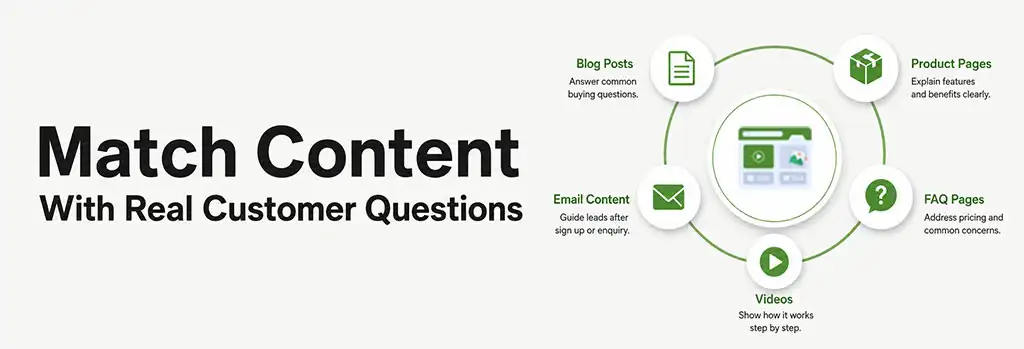
Your Content Does Not Match How People Actually Ask Questions
There is a certain gap between the keywords that businesses optimize for and the natural language people use when speaking to AI assistants.
People no longer type fragmented search queries into Google. They ask full questions in the way they would speak to a knowledgeable friend. If your content is written around rigid keyword phrases rather than conversational questions, the AI’s language model will not connect your content to the question being asked.
This is not about stuffing questions into your headings. It is about genuinely restructuring your content around the problems your customers are trying to solve.
Your Business Is Not Defined by a Clear Area of Expertise
AI systems favour specialists over generalists. If your website attempts to serve every possible client in every possible situation, the AI has difficulty assigning you authority in any single area. A business that clearly owns one topic—that publishes deeply, speaks specifically, and demonstrates repeated knowledge in a defined field—earns topical authority. Topical authority is one of the clearest signals an AI uses when deciding whose name to say. Generalist positioning, while understandable from a sales perspective, runs directly counter to how AI recommendation systems are structured.
Your Pages Load Slowly or Perform Poorly on Mobile
AI crawlers and the indexing systems that feed them prioritize content they can access reliably and quickly. A website that loads slowly, breaks on mobile, or returns errors during crawling is content that the AI cannot fully read.
For instance, if an AI assistant is building its understanding of the Toronto market in your industry and your website consistently delivers a poor technical experience, it will simply gather its information from your competitors instead.
Technical performance is not separate from your AI discoverability strategy. It is a direct input into whether your content ever gets read in the first place.
You Have Not Built Structured Data Into Your Website
Structured data is the language your website speaks directly to machines. When you add schema markup to your pages—i.e., marking up your services, your location, your reviews, and your business category—you are giving AI systems a proper, machine-readable description of who you are and what you do. Without it, AI must infer your business category, service area, and credibility from unstructured text, which introduces uncertainty. And uncertainty leads AI to favour businesses that have made themselves easy to understand.
Structured data is not complicated to implement, yet it remains one of the most consistently overlooked inputs in discussions of AI search optimization.
How Generative Engine Optimization Services in Toronto Close the Credibility Gap
The problem is not your product. It is how your business communicates its credibility to AI systems that cannot visit your shop, shake your hand, or read your reputation.
Building the Content Architecture That AI Can Navigate
Effective content for AI recommendation is organized around specific questions, structured with clear hierarchy, and written with enough depth that an AI can extract a meaningful, complete answer from a single page.
When Toronto businesses seek generative engine optimization services, the first deliverable is a content audit that maps current pages against the actual questions their customers are typing into AI assistants. Gaps in that map represent lost recommendations, and every gap is a recoverable opportunity if you put the right structure in place.
Earning the External Citations That Signal Real-World Authority
AI systems build their picture of your business from everything written about you across the web, not just from your own pages.
Building a citation profile means placing your business name, expertise, and perspective in places that AI trusts, such as industry publications, local news, professional directories, and curated review platforms. So, ‘how do I get recommended by AI’ is a question that ultimately comes back to one answer—be talked about in credible places. This is earned, not purchased, and it requires a deliberate outreach strategy rather than a passive waiting game.
Aligning Your Technical Foundation With How AI Crawls Content
Technical SEO has always mattered. For AI visibility, it matters in a different way. AI systems do not just need to index your pages. They need to read them accurately, extract clean answers, and trust that the information they find is current. This means addressing crawl errors, updating outdated content, implementing structured data, and ensuring that your site’s core architecture does not confuse the systems trying to read it.
Many Toronto businesses are sitting on strong reputations and a weak technical base—a combination that makes AI discoverability unnecessarily hard.
Positioning Your Business as the Named Expert in Your Category
AI SEO is ultimately about earning a name, not just a ranking position. The businesses AI recommends most consistently are those that have been defined by their own content and by outside sources as the go-to authority in a specific category within a specific geography.
This means choosing your niche deliberately, publishing around it consistently, and building the off-site profile that reinforces your claim to that space. Generative engine optimization services help Toronto businesses make that positioning shift from broad and forgettable to specific and highly referable.
Generative Engine Optimization Services in Toronto: The Signals That Rebuild AI Trust
Losing AI visibility is not permanent. It is a signal problem, and signal problems have solutions.
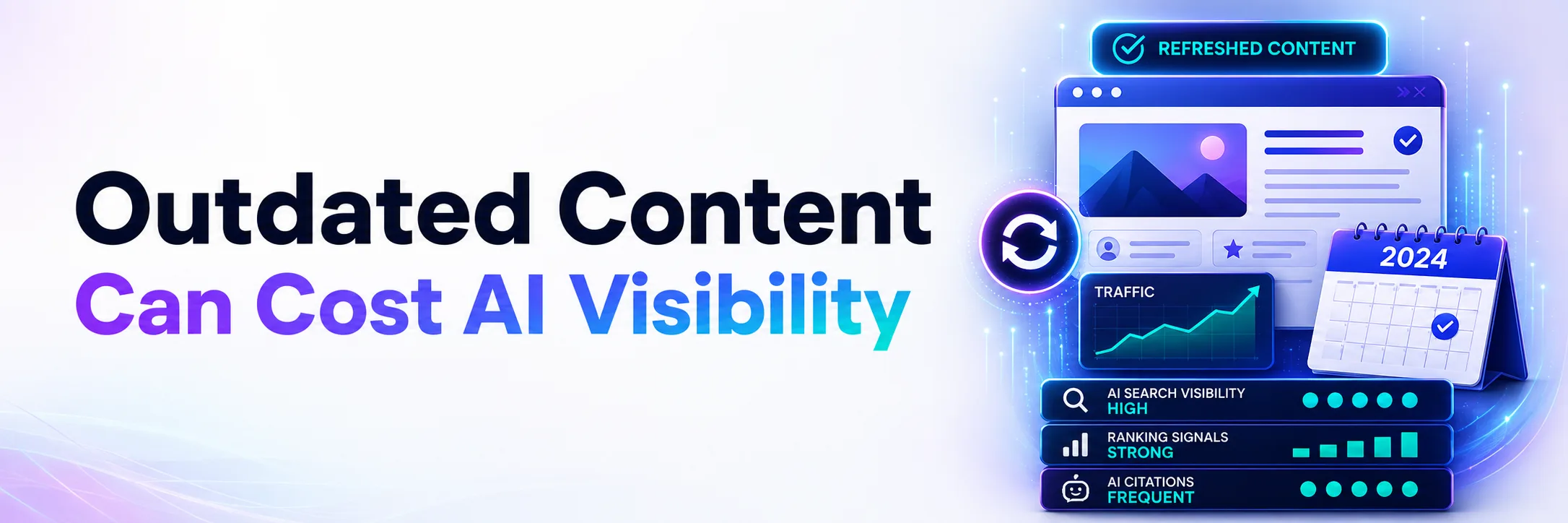
Refreshing Outdated Content Before It Costs You More Recommendations
AI systems notice when your content has not been updated. A service page last revised in 2021 carries a subtle credibility penalty in 2026. AI draws on the most current, most accurate information it can find, and businesses whose content reflects the present state of their industry via updated pricing, revised processes, and current team information signal to AI that they are active, reliable, and worth recommending.
Refreshing content is not a one-time task. It is a maintenance discipline that directly affects how often your business gets named in an AI-generated response.
Using Your Own Voice to Demonstrate Genuine Expertise
The content that earns the most AI trust is authored content, i.e., blog posts, guides, and commentary written by someone who demonstrably knows the subject.
AI systems are designed to favour content that shows original thought, cites real experience, and addresses nuance rather than repeating generic advice. For businesses in competitive Toronto markets, this means committing to regular publishing from an identifiable expert perspective. It is the kind of content that earns citations, builds topical authority, and gives AI a clear reason to connect your name to your area of practice.
Monitoring AI Outputs to Understand What Is Being Said About You
Most businesses have no idea how (or whether) they are currently represented in AI-generated responses. Regularly monitoring tools like ChatGPT, Gemini, and Perplexity, and searching for the questions your customers would ask, gives you direct visibility into how AI currently perceives your business.
This monitoring practice reveals the specific gaps in your credibility profile, i.e., which competitor is being named instead of you, what language the AI uses to describe your category, and which questions your content has not yet answered clearly enough.
Treating GEO as a Long-Term Business Asset, Not a One-Time Fix
The Toronto-based businesses that earn lasting AI recommendations are those that treat generative engine optimization as an ongoing discipline rather than a project with a finish line.
AI models update, new competitors publish, and questions evolve. The businesses that remain named are those that continue to build authority, refresh content, earn citations, and align their technical foundation with current best practices.
The compounding effect of consistent GEO work is significant. Each new citation, each updated page, and each well-structured answer adds to a credibility profile that becomes progressively harder for competitors to displace.
AI has changed the rules of how customers find businesses they trust, and Toronto companies that understand this shift are earning visibility that compounds over time. The businesses that get recommended are not always the best in their category. They are the ones that have made themselves easiest for AI to trust, read, and endorse. Investing in generative engine optimization services is how you close that gap and put your Toronto business back into the conversation where your customers are already looking.