
Most business owners have been there: you build a solid product, put up a website, and then wait. And wait. The traffic trickles in, leads stay flat, and the gap between where you are and where you want to be keeps growing. It is a genuinely frustrating place to be, especially when you know your offer is good.
The truth is that a website without an active SEO strategy is essentially a storefront on a road nobody drives down. Search engines process billions of queries every single day, and the businesses that show up consistently at the top of those results are not there by accident. They invested in a deliberate, data-informed approach to earning that visibility.
Scaling a business through search is not about chasing shortcuts or gaming algorithms. It is about building genuine authority, answering the questions your customers are already typing into Google, and ensuring your website earns trust from people and search engines. The businesses that do this well see compounding returns over time: more traffic, better leads, and stronger revenue.
Here, we discuss how to scale your business with a results-driven SEO services approach to help you build lasting online growth that delivers real, measurable business outcomes.
Scaling a business with SEO is not a single move. It is a coordinated set of actions that build on each other. Here is the framework we use, broken down into seven actionable steps.
Before you can grow, you need to know exactly where you stand. A thorough SEO audit looks at your website’s technical health, existing content, backlink profile, page speed, mobile performance, and how well your site is currently indexed. Many businesses are losing significant traffic simply because of crawl errors or broken internal links—problems that are entirely fixable once identified.
An audit surfaces the keyword gaps your competitors are filling that you are not. It reveals which of your existing pages are closest to ranking well and just need a push.
For instance, a product page sitting in position eight or nine for a high-intent keyword can often be moved to page one with targeted content improvements and a handful of quality backlinks. Think of the audit as your map. Without it, every other action you take is guesswork.
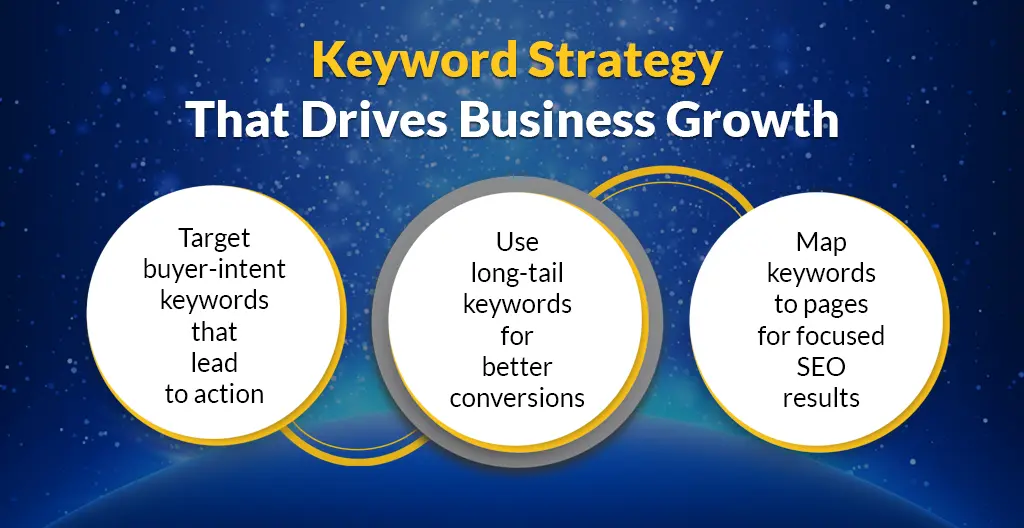
Not all keywords are created equal. A keyword strategy built on buyer intent means targeting the specific phrases that people type when they are ready to act; phrases that signal they want to buy, hire, or book, not just browse. For instance, someone searching “best SEO services for business growth” is far more valuable to your pipeline than someone searching “what is SEO.”
Longer, more specific phrases (called long-tail keywords) tend to have lower competition and higher conversion rates.
A strong keyword strategy maps each target phrase to a specific page on your site, so every piece of content has a clear purpose. Knowing how to scale your business with SEO starts here, with choosing the right words. When your content answers the exact questions that buyers are asking, search engines reward you with higher rankings and buyers reward you with their business.
Technical SEO is the foundation on which everything else rests. If search engines cannot crawl your site efficiently, or if your pages load slowly on a mobile device, no amount of great content will save your rankings.
Core areas to address include:
HTTPS security is now a ranking factor, as an unsecured site signals distrust to both users and Google. Moreover, Core Web Vitals—Google’s page experience signals—directly influence rankings and are measurable and improvable.
For instance, compressing images and deferring unnecessary JavaScript can meaningfully move the needle on these scores. Strong technical SEO turns your site into a reliable, crawlable, fast-loading platform your entire strategy can build on.
Content is not about volume; it is about value. The best SEO strategies for business growth centre on producing content that genuinely answers the questions your ideal customers are asking at every stage of the buying journey. That means informational blog posts that build awareness, comparison pages that help buyers evaluate their options, and conversion-focused landing pages that close the deal.
Each piece of content should target a specific keyword cluster and include internal links to related pages, helping search engines understand the depth of your expertise. Consistently publishing well-researched, clearly written content signals to Google that your site is an authority in your field—and authority is one of the core factors driving top rankings.
For example, a local accounting firm that publishes detailed guides on small business tax planning can rank for dozens of high-intent queries that bring in qualified leads every single month. Quality content is the engine of long-term SEO growth.
Backlinks—links from other websites pointing to yours—remain one of the most powerful ranking signals in SEO. But quality matters far more than quantity. A single link from a respected industry publication is worth more than hundreds of links from low-quality directories. Building a strong backlink profile involves earning coverage from relevant websites, contributing expert commentary to industry articles, and creating content that other sites naturally want to reference.
Broken link building, finding dead links on other sites, and offering your content as a replacement is an efficient white-hat approach. Digital PR campaigns that produce genuinely newsworthy content can earn backlinks from major publications, dramatically boosting your domain authority.
For instance, publishing original research or a proprietary data study in your industry can attract dozens of organic citations. A strong backlink profile tells search engines that your site is trusted, and trust translates directly into higher rankings and more organic traffic.
If your business serves a specific region or has a physical location, local SEO is one of the highest-return activities in which you can invest. Optimizing your Google Business Profile with accurate information, photos, service categories, and a steady stream of reviews makes your business visible in the map pack—i.e., the prominent block of local results that appears at the top of many searches. Consistent NAP (name, address, phone number) information across all online directories eliminates confusing signals that can suppress your local rankings.
Creating location-specific landing pages for each service area you cover allows your site to rank in multiple markets simultaneously. For instance, a plumbing company serving several neighbouring cities can create a dedicated, well-optimized page for each one, capturing SEO services to increase website traffic from each local area.
Local SEO is often the fastest path to measurable lead growth for service-based businesses — and results can appear within a matter of weeks when done correctly.
SEO without measurement is just hope. Tracking the right metrics, such as organic traffic growth, keyword ranking movement, click-through rates, leads generated, and revenue attributed to organic search, is what allows you to separate what is working from what is not. Tools like Google Search Console, Google Analytics 4, and rank-tracking platforms give you the data you need to make informed decisions.
A monthly reporting cadence keeps your strategy aligned with your business goals rather than vanity metrics. The SEO landscape is evolving constantly, with algorithm updates, competitor moves, and shifting buyer behaviour all requiring ongoing adaptation.
For example, when a competitor gains ground on a keyword that matters to your business, prompt analysis and action can protect your position. Results-driven SEO services are defined precisely by this commitment to continuous improvement. The businesses that scale fastest through SEO are not the ones that set it and forget it. They are the ones that treat it as an ongoing investment in measurable growth.
These steps help maintain momentum once your SEO foundation is in place.
Evergreen content continues to attract visitors long after it is first published, without needing constant rewrites or updates. It answers the foundational questions your audience keeps asking—questions that stay relevant regardless of season or trend.
These pages build consistent, predictable traffic rather than short-lived spikes that fade within days. They often become the first touchpoint for new visitors who are just discovering your brand. For instance, a well-written guide on “how to choose a flooring contractor” can rank steadily for years and keep pulling in qualified traffic. This approach supports SEO services to increase website traffic by creating compounding, long-term value that keeps working for your business around the clock.
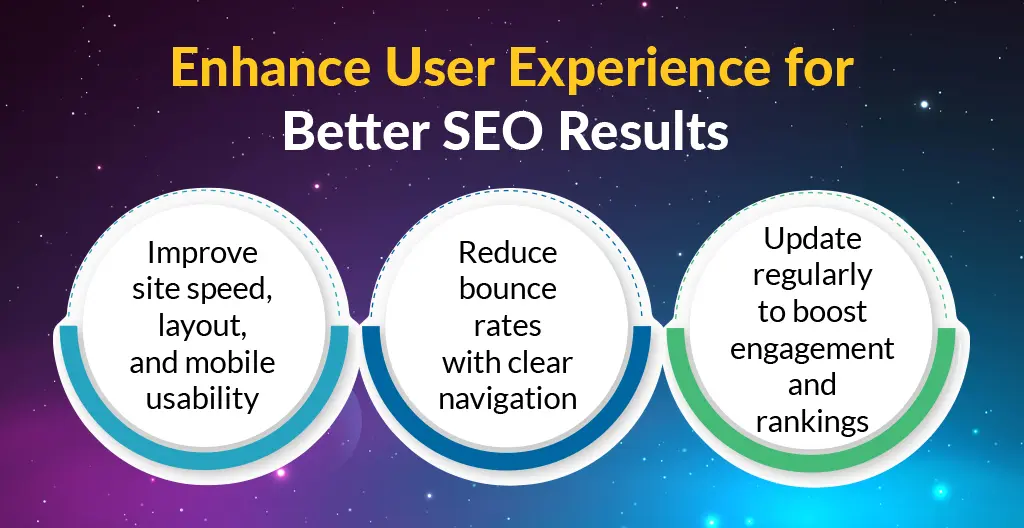
User experience is no longer a design consideration alone; it is a direct ranking factor that search engines measure and reward.
A clean layout, readable fonts, logical navigation, and fast-loading pages encourage visitors to stay longer and explore further. Search engines interpret these positive behavioural signals, lower bounce rates, and longer session durations as proof that your content is worth showing to more people.
Regular site improvements keep your experience fresh and competitive as user expectations evolve. For instance, simplifying your mobile menu or improving your page load speed can meaningfully reduce bounce rates. A better experience supports both sustained traffic growth and stronger conversion rates over time.
Guesswork is one of the costliest habits in SEO. When you let real performance data guide your content decisions, growth becomes far more deliberate and efficient.
Identify which pages are already attracting strong traffic and engagement, then build on those topics rather than starting from scratch. Creating closely related content around your top performers strengthens your topical authority, signalling to search engines that your site has genuine depth in that area. This data-led approach eliminates wasted effort and focuses your resources where they will deliver the highest return.
For instance, expanding a popular blog post into a detailed, structured guide can significantly increase its visibility, attract more backlinks, and pull in a broader range of searchers.
SEO rewards businesses that show up regularly, not just once. Consistency builds the kind of trust and stability that search engines look for when deciding which sites deserve sustained visibility.
Regular publishing, updating, and optimization activity signals to Google that your site is alive, relevant, and actively maintained—all qualities that support strong rankings over time. Steady effort creates a protective buffer against sudden drops in performance that often hit sites that go quiet for extended periods.
For instance, a simple monthly content update or a quarterly technical review can keep your rankings stable and your momentum intact. This long-term commitment is what separates businesses that briefly rank from those that consistently grow.
Here’s how businesses typically see measurable growth.
Cosmaroma is a well-established home improvement retailer with thirteen locations across Ontario and Quebec, offering vanities, doors, flooring, custom stairs, and more.
When they came to G Web Pro, their website was poorly structured for e-commerce, missing meta titles, and suffering from disorganized header tags. Their keyword strategy was misaligned with actual buyer searches, their backlink profile contained toxic links, and their Google Business Profile across all thirteen locations were incomplete.
G Web Pro resolved the technical issues, restructured the site for e-commerce usability, cleaned up the backlink profile, and optimized every GMB listing. Refined content and targeted keyword mapping closed the gap between what Cosmaroma published and what their customers were searching for.
The results arrived within six months: a 109.43% increase in organic traffic, a 115% improvement in keyword rankings moving from 748 to 1,120 ranked keywords, and stronger local search visibility across all their markets. Cosmaroma noted a significant improvement in lead quality alongside the growth in visibility.
Airline Limo is a Toronto-based premium airport transportation provider with over 70 years of experience serving Pearson International Airport and the Greater Toronto Area.
Despite their strong offline reputation, their digital presence had real gaps—no dedicated city service pages, thin content, an incomplete Google Business Profile, and slow page speeds that were hurting both rankings and conversions.
G Web Pro built city-specific landing pages to capture local search intent across the GTA, added keyword-rich content, improved page speed through image compression and code optimization, and implemented structured data for rich snippets. A full SEO audit resolved on-page issues and strengthened internal linking throughout the site.
The Google Business Profile was fully built out, and a review acquisition programme was introduced to grow local credibility. The outcome was a 112.35% year-over-year increase in organic traffic and over 3,000 Google Business Profile clicks within just six months—clicks that translated directly into qualified bookings and enquiries.
Scaling a business through search is a process, not a gamble. When you build the right foundation, target the right keywords, and stay consistent, organic growth becomes predictable. Businesses like Cosmaroma and Airline Limo prove that results-driven SEO services deliver real, measurable outcomes, not empty promises. At G Web Pro, we build strategies around your specific goals, not templates. Visit G Web Pro to explore our SEO packages and book your free consultation today.
Most businesses begin seeing measurable improvements in rankings and traffic between three and six months. Meaningful lead and revenue growth typically follows at the six-to-twelve-month mark, with results continuing to compound over time as your authority builds.
A results-driven approach ties every SEO activity directly to business outcomes, traffic, leads, and revenue rather than focusing solely on rankings. It prioritizes measurable growth, transparent reporting, and continuous strategy refinement based on real performance data.
Investment varies based on competition, goals, and scope, but quality SEO typically ranges from a few hundred to several thousand dollars monthly. The right benchmark is the return: businesses that invest strategically in SEO consistently report lower cost-per-lead than paid advertising over time.
Absolutely. Local SEO levels the playing field by helping businesses rank prominently for geographically specific searches. A well-optimized local presence, including a strong Google Business Profile and location-specific pages, can consistently outperform national brands in local search results.
Technical health, content quality, user experience, and authoritative backlinks remain core ranking factors. Additionally, Core Web Vitals, E-E-A-T (Experience, Expertise, Authoritativeness, Trust) signals, and intent-aligned content are increasingly important for sustained business growth through search.
The clearest indicators are growth in organic traffic, improvements in keyword rankings for buyer-intent phrases, an increase in qualified leads, and revenue attributed to organic search. If these metrics are not moving upward consistently, your strategy likely needs a thorough reassessment.