
The internet is changing in a way most business owners have not seen coming. For thirty years, websites have been places people visited. You clicked, you read, you bought. That model is quietly being replaced by something far more active.
Comprehending the agentic web is no longer a topic for tech conferences and innovation teams. It is now a practical question that affects how customers find you, interact with you, and decide whether to trust you with their money.
The shift is not about flashy tools or expensive experiments. It is about a basic change in how software acts on behalf of people. Businesses that understand this early will have a real advantage. Those that do not may find themselves left behind.
Here we will discuss what businesses need to know about the agentic web.
This is the core question every business leader should be asking right now—and the answer is simpler than you might expect.
For most of internet history, websites waited for humans to show up. You opened a browser, typed in a URL, and the site responded. The agentic web flips this. AI agents do not wait—they act. They browse, compare, book, and complete tasks on a person’s behalf without the person lifting a finger. These agents can work across dozens of websites in seconds.
Understanding what an agentic web is begins with recognizing that software has moved from being a tool you pick up to being an assistant that works while you sleep.
This is not a prediction for five years from now. AI agents are already being used to research products, compare prices, fill out forms, schedule appointments, and draft emails. The companies building these agents—including major players like Google, Microsoft, and OpenAI—are investing billions to make them faster and more capable. If a customer can send an AI agent to handle a task, they will. Your business needs to be ready to interact with software, not just people.
Most websites are designed around the human eye. Visual appeal, clever copy, and intuitive menus matter when a person is browsing. Agents do not care about your brand colours or your hero image. They care about structured data, clear labelling, and machine-readable content. For instance, a restaurant website with a beautifully designed menu as a PDF image is invisible to an AI agent trying to find gluten-free options. Businesses need to think about whether their digital presence is understandable to software, not just to people.
Think of it this way. Imagine you asked a very competent assistant to handle everything for you—book your flight, find the best insurance quote, order the supplies, and send the follow-up email.
Now imagine that the assistant is software, running in milliseconds, doing all of this simultaneously for millions of people. That is the agentic web explained in plain terms.
The web becomes a network of actions, not pages. Your business is no longer just a destination but a participant in an automated ecosystem.
When AI agents act on someone’s behalf, they must decide who to trust. They are trained and instructed to favour sources that are clear, consistent, and well-structured. Businesses with vague policies, inconsistent information across platforms, or poorly maintained digital profiles will get passed over—not by a skeptical human but by a machine that simply moves on to the next result.
Earning the trust of AI agents means keeping your business information accurate, complete, and up to date everywhere it appears online.
When people use AI-powered assistants regularly, their expectations shift. They get used to instant answers, zero friction, and tasks completed without effort. The future of web browsing with AI means that your customers will increasingly expect the same speed and ease when they interact with your business directly. Slow load times, confusing navigation, and unanswered contact forms will feel even more frustrating by comparison. The bar for a good customer experience is rising, whether your business has adopted AI tools yet or not.
There is a temptation to think this is an enterprise problem—something for big companies with innovation budgets.
It is not.
AI agents are already being used by regular consumers for everyday tasks. A small accounting firm, a local dental clinic, or a regional contractor can all be affected by how well their business information integrates with the emerging agentic ecosystem.
The good news is that getting ready for this change does not require a massive investment. It requires clarity, consistency and a willingness to understand how your digital presence functions beyond what a human visitor sees.
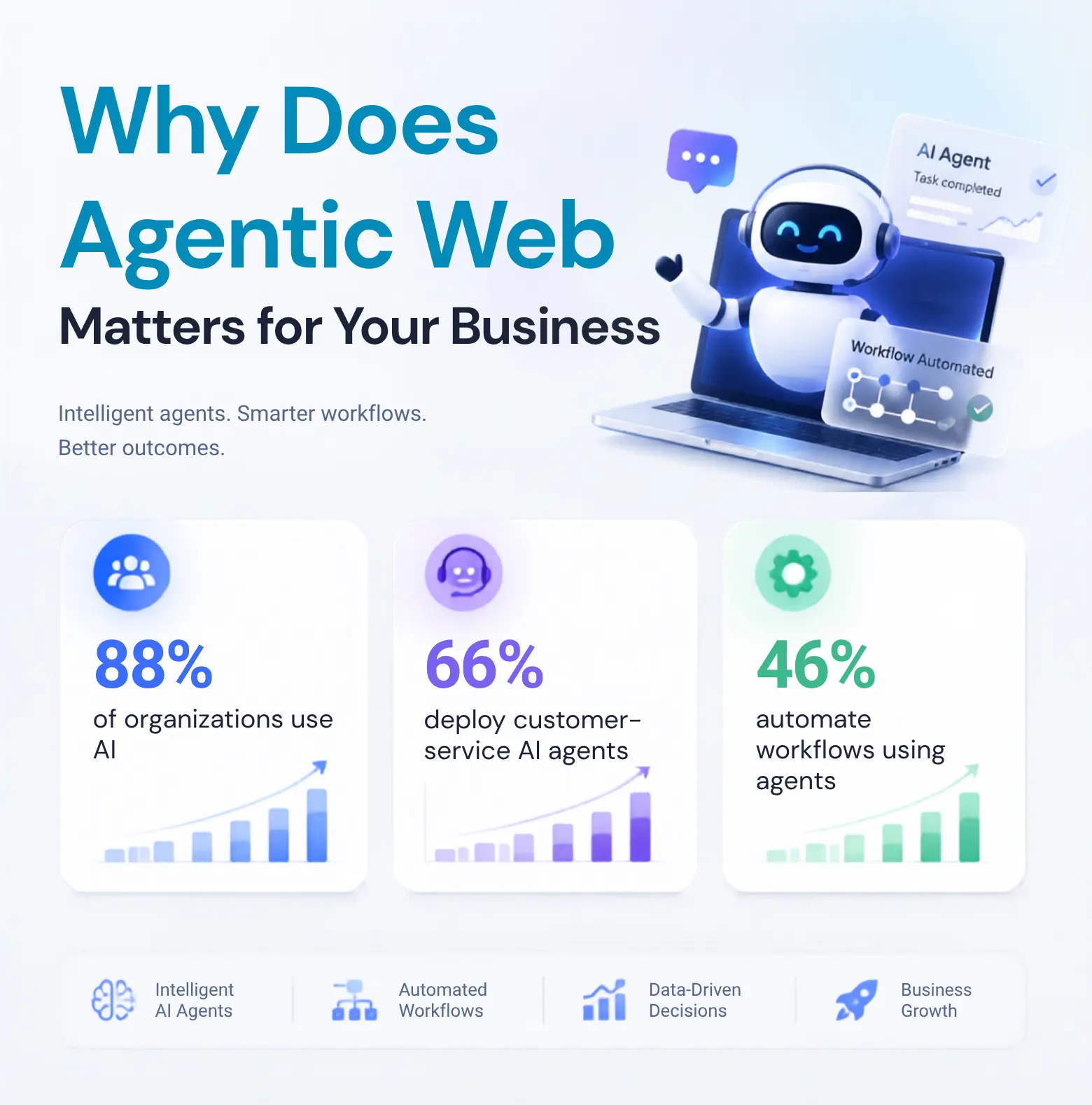
Understanding what happens technically is only half the picture. Here is what it means in practical terms for how you show up online.
Structured data is information on your website coded in a way that machines can read reliably. It tells search engines and AI agents exactly what your business does, what your hours are, what products you carry, and how to interact with your services.
For years, structured data was treated as a nice to have for SEO purposes. In the agentic era, it is becoming a requirement.
The connection between AI agents and websites depends almost entirely on how well your information is organized beneath the surface. If your backend is messy, agents simply skip you.
Most content is written to persuade, inform, or entertain human readers. That still matters. But now there is a second audience: software that parses your content to answer questions, complete tasks, and make decisions.
Your FAQ pages, service descriptions, and product listings need to be clear enough for a machine to understand without context or interpretation. Plain language is no longer just a writing virtue but a technical requirement. Ambiguous phrasing, industry jargon, and vague calls to action create gaps that agents cannot bridge.
An AI agent gathering information about your business does not stop at your website. It checks review platforms, business directories, social profiles, and partner sites. If your phone number is different on Google than it is on your own Contact page, that inconsistency raises a flag. If your hours on Yelp are outdated, an agent might recommend a competitor instead.
Managing your digital footprint used to be a marketing concern. In the agentic web, it is an operational one. Every platform where your business appears is now part of how you get selected—or skipped.
The classic customer journey—awareness, consideration, decision—assumed a human was making each move. Now, agents can handle entire segments of that journey automatically.
A person might say to their AI assistant: “Find me a reliable HVAC company in Edmonton that has good reviews and offers weekend appointments.” The agent does the research, filters by criteria, and presents two or three options.
If your business is not showing up at each stage of that automated journey—with the right information in the right format—you are not in the running. The customer never even knows they passed you by.
The practical steps matter more than the theory. Here is what to do.
Start by looking at your business from the outside in. Search your own name on Google. Check your Google Business Profile. Pull up your website on a mobile device.
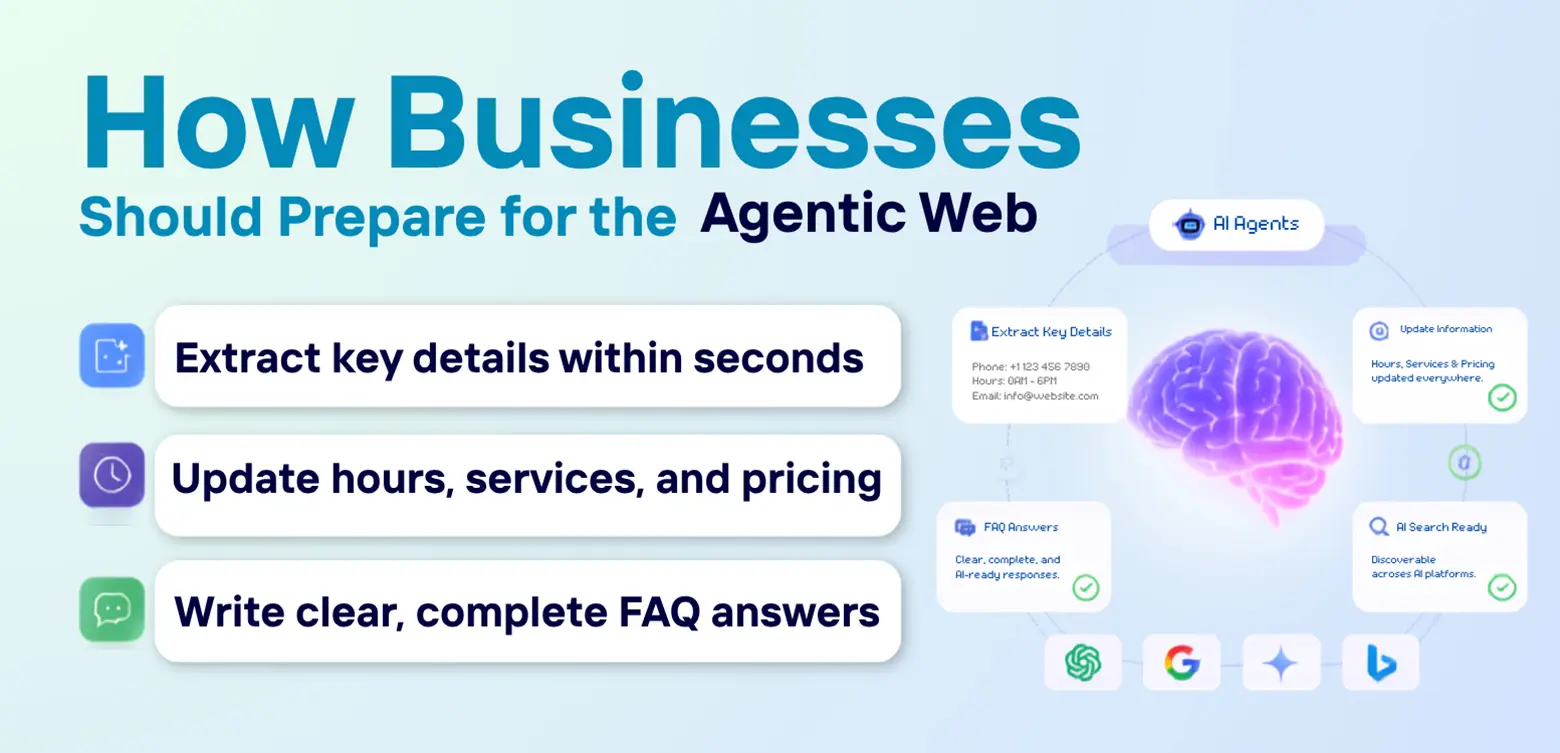
Ask yourself: if a piece of software were trying to extract your business hours, your main services, your location, and your pricing, could it do so in under ten seconds? If the answer is no, you have work to do.
This does not require a developer. It requires honest assessment and a willingness to fix what is broken, outdated, or unclear.
This is the single most accessible change any business can make right now. Write service descriptions in detail that leave nothing to interpretation. State your prices clearly or explain exactly how a customer can get a quote. Answer the most common questions in a dedicated FAQ section, using the exact words your customers use when they ask.
Plain, complete, well-organized information is what allows AI agents to accurately represent your business to potential customers. It is also what builds trust with the people who read it afterward.
Many business owners feel uneasy about AI agents because it feels like losing control of the customer relationship. That unease is understandable. But the more logical way to think about it is as an opportunity to extend your reach. An agent that accurately books an appointment, answers a pricing question, or routes a customer to the right service page is doing your front desk a favour. The businesses that will benefit most are those that prepare their systems and information to work well within automated workflows, rather than those that resist the change until it becomes impossible to ignore.
You do not need to rebuild your entire digital infrastructure this quarter. Start with one clear action: clean up your Google Business Profile. Then move on to your website’s FAQ. Then audit your service descriptions.
Small, consistent steps in the right direction add up quickly. The agentic web is still evolving, and no one has a perfect playbook yet. The businesses that will lead are not necessarily the ones that move fastest—they are the ones that stay curious, keep their information clean, and treat digital presence as a living part of the business, not a one-time project.
The agentic web is not coming. It is already here, moving quietly in the background of how people search, decide, and act online. For businesses, the question is not whether to pay attention to what the agentic web is but how quickly they can get their digital house in order to participate in it well. The good news is that the foundations—clear information, consistent presence, plain language—are things any business can build. Start there, and you will be better positioned than most.
The agentic web is a version of the internet where AI software completes tasks—searching, booking, comparing, and buying— on behalf of people without the person manually clicking through websites. It makes the web more active than passive.
Not immediately, and perhaps not entirely. But websites will need to serve both human visitors and AI agents. The businesses that structure their information for both audiences will have a significant advantage in how they get found and selected.
Yes, but without panic. AI agents are already used by everyday consumers. Small businesses that keep their online information accurate, clear, and consistent will naturally be better positioned, even without major investment in new technology.
Focus on structured data markup, plain and complete service descriptions, up-to-date business profiles across all platforms, and removing ambiguous or outdated information. These steps improve both the machine readability and the human experience.
A chatbot responds to questions within a single conversation window. An AI agent can take independent actions across multiple platforms and systems like booking, researching, comparing and executing tasks on a person’s behalf without ongoing instruction.
Very. Major technology companies are actively building and deploying agentic systems right now. Consumer adoption is increasing as AI assistants become more capable and widely available. Businesses have a narrow window to get ahead of this shift proactively.