
The summer of 2026 is shaping up to be one of the most exciting in modern sports history. For the first time ever, three countries will co-host the FIFA World Cup, with Canada, the United States, and Mexico sharing the tournament across sixteen host cities. Millions of visitors from every corner of the globe are expected to attend.
For tourists, this creates an extraordinary opportunity and a very real need to plan well in advance. Flights, accommodations, and match tickets are already being watched closely by travellers on every continent. The window to secure the best experience is closing fast. Those who wait will pay more or miss out entirely.
Canada’s two host cities are Toronto and Vancouver. Each brings its own distinct flavour to the tournament. Whether you are drawn to Toronto’s multicultural urban energy or Vancouver’s stunning coastal setting, the Canadian legs of this tournament will deliver memories that go well beyond the pitch.
Here we will discuss preparation for the 2026 FIFA World Cup and what tourists must know to help them plan their trip with confidence, clarity, and genuine peace of mind.
TABLE OF CONTENTS
Getting these seven fundamentals right before you leave home will save you money, stress, and a lot of wasted time on the ground.
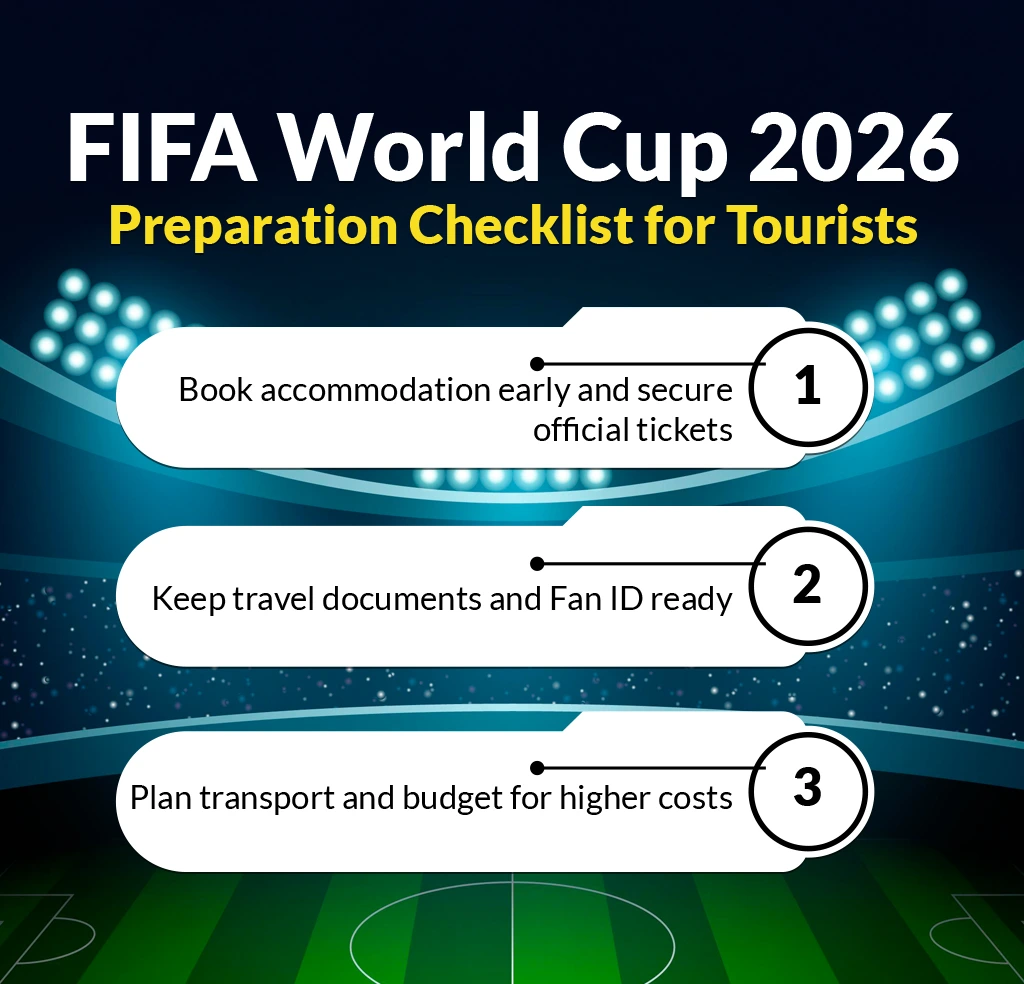
If there is one piece of advice that towers above all others for FIFA World Cup tourism, it is this: book your accommodation now if you have not already done so. Host cities like Toronto, Vancouver, Dallas, New York, and Mexico City are already seeing surges in hotel demand for June and July 2026. Major sporting events of this scale are notorious for inflating room rates by 200 to 400 percent as the event approaches. Budget options disappear first and fast.
Do not assume you will find something reasonable in the weeks before the tournament. Look beyond hotel chains and consider licensed short-term rentals, serviced apartments, or staying in a neighbouring city and commuting by train. Give yourself a realistic budget that includes transit costs. Lock in something with a flexible cancellation policy while you still have room to adjust your plans.
FIFA manages its own ticket sales, and the process has historically involved multiple lottery-style ballot phases, early registration periods, and resale windows. For FIFA World Cup 2026 preparation, registering on FIFA’s official platform as early as possible is essential. Avoid any third-party reseller sites that are not officially sanctioned by FIFA. The risk of counterfeit tickets is very real, and FIFA’s stadium verification systems are strict.
If you miss the official ballot window, FIFA typically releases returned and unsold tickets closer to match dates. Match tickets are linked to your identity, so bring the same ID you registered with. Also consider that group stage tickets are generally more available than knockout rounds. A pool match can still deliver an incredible atmosphere and is far easier to secure than a semifinal.
Canadian, American, and Mexican passport holders will find entry into their host country relatively straightforward. But for international visitors, particularly those arriving from countries that require visas to enter Canada, the United States, or Mexico, the paperwork can be involved. FIFA World Cup travel tips from previous tournaments consistently highlight documentation as the most common source of last-minute panic.
Some countries have specific entry agreements with host nations during major tournaments, but these are never guaranteed. Make sure your passport has at least six months of validity beyond your planned departure date.
If you are crossing borders between host nations, such as attending a match in Dallas and then travelling to Toronto, you will need to meet each country’s entry requirements independently.
Every host city will experience significant transportation strain during match days. Subways, buses, and ride-share platforms are all going to be far busier than you expect. Part of your FIFA World Cup 2026 preparation should include mapping out how you will get to and from the stadium on match day. Know your backup plan, too.
In Toronto, the TTC and GO Transit offer solid coverage, but expect delays on packed game days. In Vancouver, the SkyTrain runs reliably and connects directly to BC Place. Walk the route on a non-match day if you arrive early enough. Buy transit passes in advance where you can. Avoid renting a car for match days, as parking near stadiums will be expensive, scarce, and frustrating.
A World Cup host city is not operating at its typical tourism pricing. Restaurants near stadiums will charge premium rates, and even grocery stores in central areas will feel pricier during peak tournament weeks. A solid World Cup 2026 tourism guide will always tell you to set a daily spending budget at least 30 to 40 percent higher than what you might normally spend in that same city.
Build in a contingency fund for the unexpected. A missed train might require a taxi. A restaurant being fully booked might send you somewhere pricier. Travel insurance is not optional for a trip of this scale and cost. Look for policies that cover event cancellation, medical emergencies, and trip interruption clearly and specifically.
FIFA has implemented Fan ID systems at several previous World Cups, and some version of visitor credential or registration is expected for 2026. These systems are designed to manage crowd flow, reduce ticket fraud, and help authorities maintain safety at mass events.
As part of your travel advice for the FIFA World Cup, make sure you understand whatever registration or identity system FIFA has announced. Keep both digital and printed copies of all your credentials. This includes your match tickets, your Fan ID or equivalent, your accommodation confirmation, and your travel insurance documentation. Store everything in a cloud folder you can access from any device. Losing paper documents in a crowd is very easy to do. Redundancy here is the mark of a seasoned traveller.
This is not just courtesy; it is genuinely practical advice. Toronto and Vancouver each have different and unique identities that go well beyond their role as FIFA World Cup host cities. Vancouver carries a deep Indigenous heritage and a significant Asian Canadian community, so bring curiosity and genuine respect. Toronto is one of the most diverse cities on the planet, and its neighbourhoods each have their own rhythms.
Beyond Canada, cities like Los Angeles, Miami, and Mexico City bring equally distinct social fabrics. Know the local tipping customs and understand the laws around public drinking in each city you visit. Be a guest who leaves each city a little better than you found it. That attitude costs nothing and adds everything to your experience.
For many tourists, the real adventure involves attending matches in more than one city. Here is how to make that work without burning out or breaking your budget.
Between Toronto and other eastern cities, the VIA Rail corridor is comfortable and avoids the stress of airport security during a peak travel period. Amtrak in the United States connects several host cities, though journey times can be long.
For cross-border travel between Canada and the United States, be prepared for customs and immigration even on trains. Book your intercity rail tickets early because prices rise sharply as events approach. A multi-city rail pass can offer savings if you are visiting three or more cities.
Flying is faster but adds cost, airport stress, and baggage hassle. For trips under five hours, rail is often the smarter and calmer choice.
If you need to fly to attend the FIFA World Cup, plan your itinerary carefully and book refundable or change-friendly fares whenever possible. Tournament schedules can shift because match dates for knockout rounds are confirmed only as teams advance. Being locked into a non-refundable flight creates real financial risk. Use flight aggregator tools to monitor price trends and set alerts for your target routes. Flying on a Tuesday or Wednesday is consistently cheaper than weekend travel. Pack light to avoid checked baggage fees, particularly on budget carriers, and arrive at airports earlier than you think you need to. Passenger volumes during the tournament will be meaningfully higher than normal seasonal traffic.
Not every moment of the World Cup requires a match ticket. Every host city will have official FIFA Fan Zones where you can watch matches on large screens, enjoy live entertainment, and soak up the atmosphere without spending much at all. These areas are particularly family-friendly and offer a real sense of the global community that makes the World Cup unique. Arrive early on key match days because Fan Zones fill up quickly and capacity limits are enforced for safety. Bring layers, sunscreen, and a portable phone charger. The energy in these spaces during a match involving a major footballing nation is genuinely electric and entirely free to experience.
Stadium food is expensive, limited in variety, and often not very good. One of the most practical pieces of advice for any large sporting event is to eat a solid meal before you leave for the match. In each host city, a short walk or transit ride away from the venue will take you to neighbourhoods with excellent, affordable food. In Toronto, Kensington Market and St. Lawrence Market are beloved local institutions worth visiting. In Vancouver, the Granville Island Public Market is outstanding and easy to reach. Prioritize eating local, eating well, and saving your spending for the experiences that matter most to you.
Millions of people in a concentrated space over a short period create conditions that require some basic but important planning.
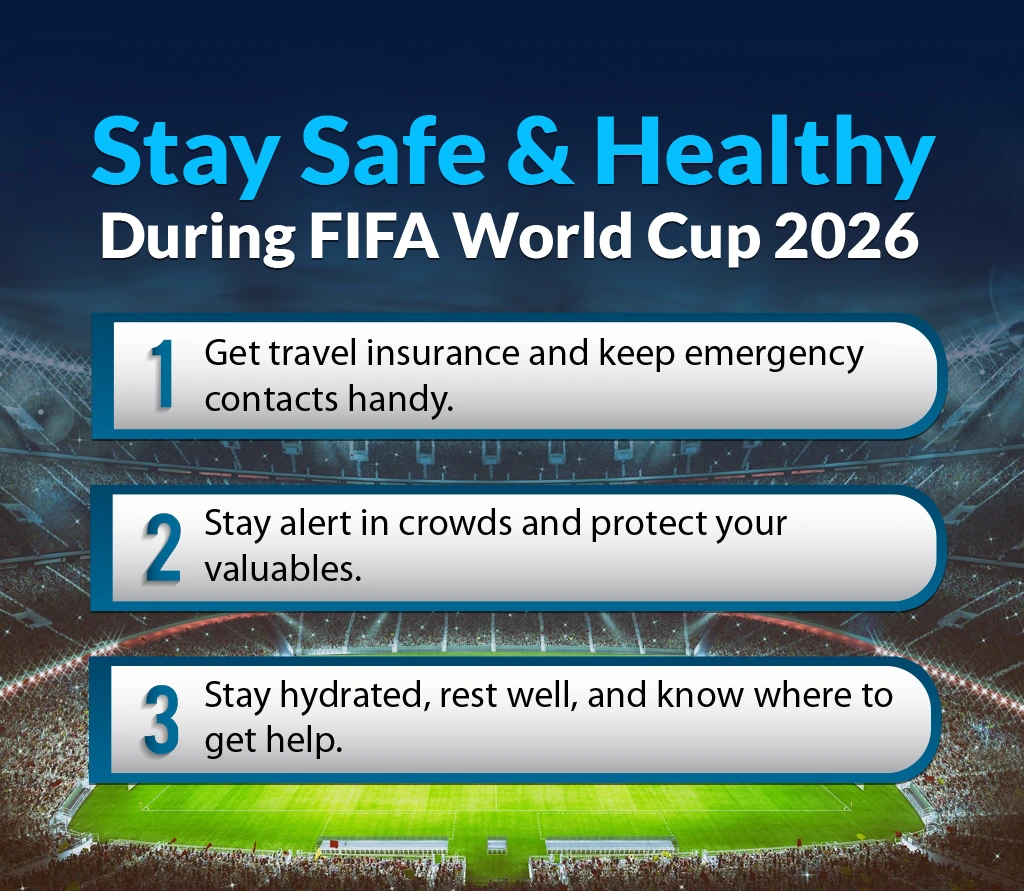
For a trip of this financial and emotional investment, travel insurance is not an optional add-on. A solid policy should cover medical emergencies, trip cancellation due to illness, event cancellation, lost luggage and emergency evacuation.
Read the policy carefully before you purchase it. Some policies exclude pre-existing conditions or have gaps around natural disasters or political disruptions. Pay close attention to the medical coverage limits. Healthcare in the United States can be very expensive for visitors, and even a minor emergency room visit can cost a lot of money without coverage. Canadian provincial health plans offer limited to no coverage outside Canada. Get a policy, read it, and always carry the emergency number with you.
Large, jubilant crowds are wonderful, and they also require a level of situational awareness. Keep your valuables in a front-facing bag or money belt rather than a backpack. Share your daily itinerary with someone back home. Know the emergency contact numbers for each city you visit. The number 911 works in both Canada and the United States, and 911 or 112 works in Mexico. Designate a meeting point with your travel companions at every venue in case you get separated. Avoid flashing expensive electronics in densely packed areas.
None of this is cause for anxiety. It is simply the habit of a traveller who has thought things through before something goes sideways.
Weeks of travel, irregular sleep, rich food and the emotional intensity of a tournament can wear you down. Pace yourself and add rest days into your schedule. Days with no matches and no fan zones, just a neighbourhood walk and a good meal, matter more than you think.
Stay hydrated, particularly on warm summer days when you are spending hours outdoors. If you take regular medications, bring more than enough supply and a doctor’s note. The Canadian summer can be hot and humid, particularly in Toronto in July. Sunscreen, a reusable water bottle, and comfortable shoes will do more for your trip than any app or gadget.
Each host city will have dedicated FIFA World Cup support infrastructure, including information booths, multilingual staff at transit hubs, and tourist assistance lines. Canada’s host cities are well equipped for international visitors, with multilingual staff in airports and transit stations.
Know the location of your country’s nearest consulate or embassy in each host city before you arrive. If your passport is lost or stolen, you will want that information immediately and not after an hour of panicked searching. Keep a photocopy packed in your luggage. Download offline maps of each city because your roaming data plan may not hold up when networks are strained by millions of simultaneous users.
The FIFA World Cup rarely comes to North America. With three incredible host nations and sixteen cities opening their doors, this is one of the most ambitious sporting events ever attempted. Good FIFA World Cup 2026 preparation will not take the spontaneity out of your trip. It will protect it. Plan the logistics with care, be a generous and curious visitor, and then let yourself be swept up in the colour, the passion, and the once-in-a-lifetime atmosphere that only the World Cup can create. You have earned this trip. Make it count.
Tickets are sold exclusively through FIFA’s official ticketing platform. Avoid third-party resellers not sanctioned by FIFA, as counterfeit tickets are common and stadium entry systems will reject them without exception.
It depends on your nationality. Many countries have visa-free access to Canada, but others require a Visitor Visa or an Electronic Travel Authorization. Check the Government of Canada’s official immigration website.
Canada has two host cities: Toronto and Vancouver. Toronto’s BMO Field and Vancouver’s BC Place will each host several matches, including group stage games and knockout round fixtures. These will be the first-ever FIFA World Cup matches played on Canadian soil.
Yes, strongly so. Medical costs in the United States can be devastating without coverage. A good policy also protects your investment if illness or flight disruption forces a change in plans. For Canadians, your provincial health plan offers very limited protection once you leave Canada.
Pack layers for cool evenings, sunscreen and a hat for outdoor Fan Zones, and a portable phone charger. Bring a compact crossbody bag for valuables and printed copies of all important documents stored separately from your phone.