
 Perplexity
 ChatGPT
 Claude
 Gemini
 Grok
Grok
If you have been watching your website traffic drop over the past year, you are not imagining it.
Something fundamental has changed in how people find information online. The search bar is no longer their first stop. AI assistants, chatbots, and generative search engines like Perplexity AI, ChatGPT Search, Google Search AI Mode, and Microsoft Copilot are now answering their questions directly, and millions of people never click through to a website at all.
The businesses showing up in those AI-generated answers did not get there by accident. They followed a deliberate set of practices that made their content easy for AI systems to read, trust, and cite. If your website is not appearing, it is almost certainly because your content has not been built with those practices in mind.
This gap is closing fast. Companies that understand what AI search engines are looking for are pulling ahead, while strong, credible businesses remain invisible simply because their digital content was written for an older version of the internet.
Here, we will discuss why your website isn’t appearing in AI search results so you can understand exactly what needs to change in order for your business to get found where your customers are looking.
Table of Contents
- Why Generative Engine Optimization Determines Who Gets Found in AI Search
- 1. Is Your Content Actually Answering Specific Questions?
- 2. Does Your Site Lack the Structured Data AI Needs to Parse It?
- 3. Is Your Site Being Seen as a Credible, Authoritative Source?
- 4. Are You Missing the Conversational Tone That AI Systems Prefer?
- 5. Is Your Content Too Thin to Be Trusted?
- 6. Have You Ignored the Importance of E-E-A-T Signals?
- 7. Is Your Technical Foundation Slowing You Down?
- How a GEO Strategy Closes the Gap Between You and AI Visibility
- What AI Search Ranking Factors Actually Measure About Your Content
- FAQ
Why Generative Engine Optimization Determines Who Gets Found in AI Search
The rules have changed, and most websites have not caught up. This section breaks down the core reasons your content is being passed over.
Is Your Content Actually Answering Specific Questions?
The most common reason a website gets skipped by AI search engines is that its content does not answer specific questions directly. Most business websites are written to impress visitors, not to inform them. They describe services in broad terms, use vague language, and bury the useful detail under layers of marketing copy.
AI systems are built to find the clearest, most direct answer to a user’s question. If your page takes three paragraphs to get to the point, an AI will find a page that does it in one sentence.
Generative engine optimization begins with this fundamental shift: write to answer, not to impress. Every page should have a clear question it is answering, stated plainly near the top, followed by a grounded and factual response.
Does Your Site Lack the Structured Data AI Needs to Parse It?
AI search engines do not read websites the way humans do. They parse structured signals, and without proper schema markup, your content is much harder to process and cite. Schema markup is a layer of code that labels your content, telling search systems what type of information they are looking at.
A business address, a product price, a how-to guide, an FAQ, a review—all of these can be tagged explicitly so AI systems know exactly what they are reading. When this labelling is absent, your content competes at a significant disadvantage against sites that have taken the time to implement it.
Structured data is not optional anymore. It is one of the clearest signals you can send to help AI systems trust and surface your content reliably.
Is Your Site Being Seen as a Credible, Authoritative Source?
AI systems prefer to cite sources that have established credibility, and they measure that credibility through signals your site either has or does not. These signals include:
- The quality of websites linking to you.
- Whether your content is cited elsewhere online.
- How long your domain has been active.
- How consistently your business information appears across directories and platforms.
Thin content, outdated pages, and inconsistent contact information all reduce your authority score. If your website has not been actively maintained or built with credibility-earning content, AI systems will route around it. Building authority takes time, but it starts with auditing what signals your site is currently sending.
Are You Missing the Conversational Tone That AI Systems Prefer?
Most business writing is formal and keyword-dense. That style was built for traditional SEO, where matching exact search terms mattered most.
AI search works differently. It processes natural language and looks for content that mirrors how people actually speak and ask questions.
If your website reads like a brochure rather than a conversation, it is likely being filtered out. Rewriting your content in a natural, conversational tone does not mean making it unprofessional. It means writing the way a knowledgeable colleague would explain something to a client. Short sentences, easy-to-understand words, and direct answers all improve your chances of appearing in AI-generated responses. For instance, a FAQ section written in easy language can outperform a long service description.
Is Your Content Too Thin to Be Trusted?
AI systems do not just look for an answer. They look for context, depth, and completeness. A page with 200 words telling visitors that your company offers great service is nearly invisible to generative search. AI search ranking factors weigh content depth heavily. A well-developed page that explains what a service is, who it is for, how it works, and what results it produces will consistently outperform a thin page.
This does not mean padding your content with filler words. It means genuinely covering a topic so that anyone reading your page leaves knowing more than when they arrived. Depth signals expertise. Expertise signals trust. And trust is what earns a citation in an AI-generated answer.
Have You Ignored the Importance of E-E-A-T Signals?
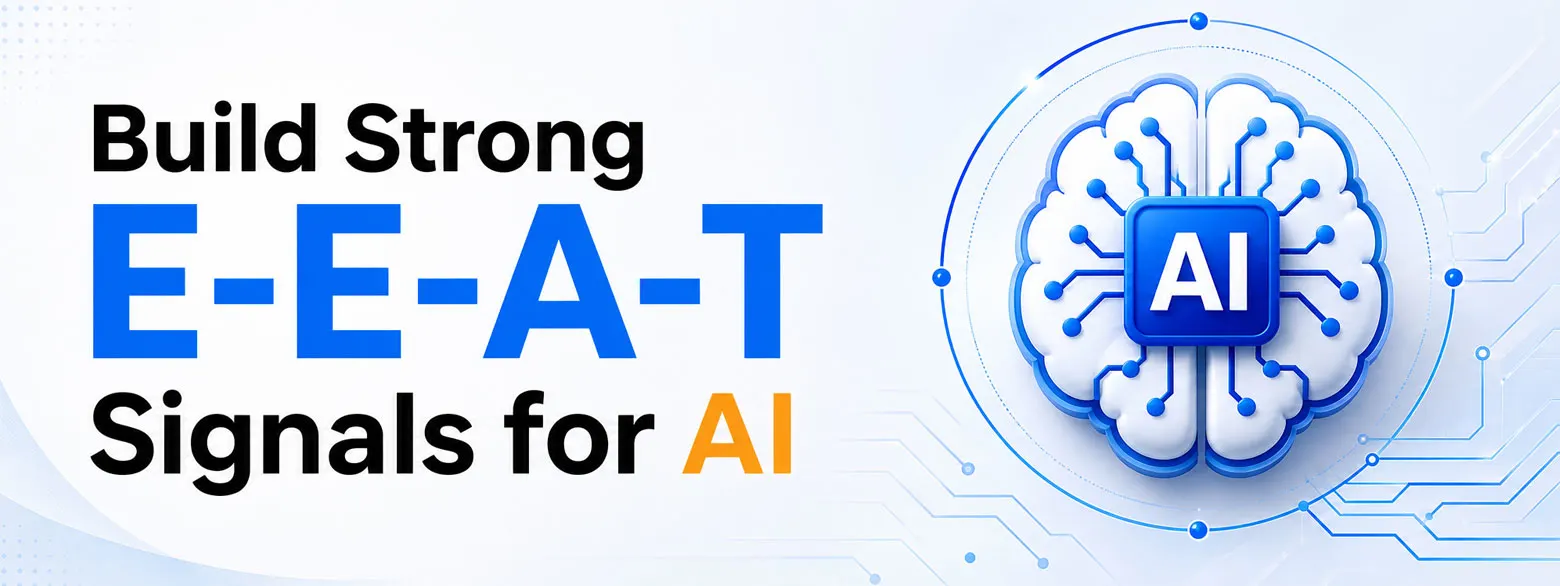
Google introduced the concept of Experience, Expertise, Authoritativeness, and Trustworthiness as a quality framework, and AI systems have absorbed this thinking deeply.
Your website needs to demonstrate who is behind it, why they are qualified, and what genuine experience they bring. Author bios, credentials, case studies, client results, and transparent About pages all contribute to these signals. A website that appears to have been written by no one in particular, with no named authors and no evidence of real-world experience, will consistently lose to a site that shows its work.
Your credibility is not just something visitors feel. It is something AI systems measure through the presence or absence of these specific signals.
Is Your Technical Foundation Slowing You Down?
All the great content in the world will not help if your website is technically broken. Page speed, mobile responsiveness, crawlability, clean URL structures, and proper canonical tags are the foundation that everything else rests on. If AI crawlers cannot efficiently access your pages, they will not index them fully. If your pages load slowly, they signal poor quality. Broken internal links, duplicate content, and missing meta descriptions all create friction.
A technical audit of your website is not glamorous work, but it is often the fastest way to remove barriers that have been silently holding you back. Think of technical SEO not as a separate discipline but as the infrastructure your content depends on.
How a GEO Strategy Closes the Gap Between You and AI Visibility
Getting found in AI search requires more than fixing individual pages. It requires a coordinated approach across your entire digital presence.
Should You Be Building Topic Clusters Instead of Isolated Pages?
A single well-written page will rarely earn consistent AI visibility on its own. What earns sustained presence is a topic cluster, a group of interlinked pages that collectively establish your website as an authoritative home for a specific subject.
A GEO strategy built around topic clusters tells AI systems that you do not just have one good answer; you have deep, connected knowledge across a domain. Your main service page becomes the hub, supported by detailed blog posts, FAQs, comparison guides, and case studies that all link back to it. This interconnected structure is far easier for AI to navigate and cite than a collection of unrelated pages that happen to share a domain.
Are You Consistently Earning Mentions Outside Your Own Website?
AI systems do not only look at your website. They look at the broader web to determine whether your brand is recognized and cited by others. Mentions in industry publications, guest contributions, podcast appearances, partner websites, and press coverage all build the kind of off-site credibility that AI search engines factor into their sourcing decisions. A business that exists only within its own website is a weaker citation candidate than one that has a genuine presence in its industry.
This is not about chasing backlinks for their own sake. It is about genuinely participating in your field so that your authority is visible from multiple directions.
Is Your Local Information Consistent Enough to Be Trusted?
For businesses serving a specific geography, local consistency is a critical trust signal that directly affects AI search visibility. Your business name, address, and phone number need to appear identically across your website, Google Business Profile, Bing Places, and every directory where you are listed. Discrepancies, even minor ones like an abbreviated street name, create doubt in AI systems that are trying to verify your legitimacy.
Beyond basic contact information, your Google Business Profile should include current hours of operation, service descriptions, and regularly updated posts. The more complete and consistent your local presence, the more confidently AI systems will include you in location-relevant answers.
Are You Reviewing and Refreshing Content on a Regular Schedule?
AI systems favour fresh and recent content. A blog post from four years ago that has never been updated is a weaker citation than a post that was reviewed and refurbished recently.
This does not mean rewriting everything constantly. It means building a regular review cycle into your content workflow. Check your top-performing pages every six to twelve months and ask whether the information is still accurate, whether new developments in your industry warrant an update, and whether the content still answers the questions your audience is asking.
Freshness signals ongoing attention and commitment, and AI systems interpret that as a mark of reliability.
What AI Search Ranking Factors Actually Measure About Your Content
Understanding the specific criteria AI systems apply helps you prioritize where to focus your effort.
Does Your Content Demonstrate Real-World Experience?
One of the clearest signals that separates trusted sources from generic ones is evidence of direct experience. AI search ranking factors give weight to content that reflects firsthand knowledge.
This shows up in the specificity of your examples, the accuracy of your descriptions, and the presence of outcomes that only someone who has done the work would know to mention. Vague generalizations are easy to generate and easy to dismiss. Specific, grounded observations drawn from real client work, real project outcomes, and real industry knowledge are much harder to fabricate and much more likely to be cited. Write from what you actually know and have actually done.
Is Your Content Easy to Scan and Summarize?
AI systems are, among other things, summarization engines. They look for content that lends itself to being excerpted, paraphrased, and cited in a short answer.
If your pages are dense walls of text with no clear hierarchy, they are harder to summarize and therefore less likely to be cited. Use clear headings, short paragraphs, and well-organized sections that each address a distinct point.
A well-structured page does not just help human readers find what they need. It helps AI systems identify which part of your page answers which type of question. Legibility is not just a UX concern. It is also a ranking signal.
Are You Answering the Follow-Up Questions Too?
When someone asks an AI assistant a question, they often have follow-up questions that naturally arise from the answer. Websites that anticipate and answer those follow-up questions within the same page are far more useful to AI systems than those that address only the surface question.
This is the logic behind FAQ sections, related content links, and detailed explainer paragraphs. Think about what your target reader would logically want to know after getting your initial answer and then answer that too.
This approach deepens your content, signals genuine expertise, and increases the number of queries for which your page is a relevant source.
Are You Tracking Where and How AI Systems Are Citing Your Competitors?
One of the most practical things you can do to improve your AI visibility is to understand what is already working for the websites that are being cited in your space. Search for the questions your customers ask using AI-powered tools and study which sources appear consistently. Look at how those pages are structured, what kind of content they contain, what credentials they display and how they handle technical signals.
This is not about copying. It is about understanding the standard that AI systems have set for your topic area and building content that meets or exceeds it. Competitive analysis remains as important in AI search as it ever was in traditional SEO.
Visibility in AI search does not come from luck or volume alone. It comes from building content that AI systems can trust, parse and cite with confidence. Generative engine optimization is the discipline that makes that possible, and it rewards businesses that are willing to do the real work of creating accurate, structured, expert-driven content. A renowned digital marketing agency works with Canadian businesses every day to close the gap between strong service delivery and strong digital visibility. The websites that show up in AI answers are not always the biggest. They are simply the best prepared.