
The conversation around AI writing tools has shifted. Businesses that jumped on the first AI tool they found are now rethinking, looking at their results, and making a switch. The quality gap between what different AI tools produce is real, and it shows up in rankings, bounce rates, and the trust readers place in your brand.
Growing businesses—the kind with revenue on the line—are paying closer attention to that gap. They are also asking harder questions about which tool delivers content that ranks, reads well, and holds up over time. The answer they are landing on more and more often is not the most popular name in the room.
Claude vs. ChatGPT for SEO is a comparison that matters far more than most business owners realize. The differences are not just superficial. They tend to affect how your content performs, how much editing your team does, and how confidently you can publish.
Let’s discuss why growing businesses are choosing Claude over ChatGPT for their SEO content strategy.
The shift from ChatGPT to Claude is happening subtly, but it is happening. Here is a closer look at the reasons behind it.
One of the first things content teams notice when they switch is how much less editing they need to do. Claude’s outputs read like a professional writer wrote them—with clear sentence rhythm, logical flow, and a consistent voice. ChatGPT, particularly in its default settings, tends toward a kind of generic corporate smoothness that editors end up rewriting paragraph by paragraph. For a growing business investing in the best AI tool for their SEO content strategy, the amount of human editing time required directly affects your cost per published piece.
Cleaner prose tends to hold reader attention longer, which improves dwell time—a signal that search engines use to assess content quality. When your content reads like a real person wrote it, readers are more likely to share it, connect with it and come back for more. That combination of less editing time with stronger reader engagement is exactly what makes prose quality a business metric, not just an aesthetic preference.
Long-form content—think 1,500 to 3,000 words—is where AI tools tend to drift. They start strong and then wander, often repeating points or introducing ideas that have nothing to do with the original brief. Claude holds the narrative thread. It maintains the structure you set at the start and carries it through to the conclusion without the kind of mid-article fog that plagues many ChatGPT outputs. This matters a lot for SEO, where topic depth and content cohesion are important factors that Google’s helpful content guidelines acknowledge and reward.
When you are producing pillar pages or cornerstone articles designed to rank for competitive keywords, a single piece needs to be airtight from the first paragraph to the last. Claude’s training makes it better at following detailed outlines and complex instructions, which means your brief actually gets executed, not partially interpreted.
For a team producing long-form content regularly, that structural discipline is the difference between a first draft you can work with and one you have to rebuild from scratch.
Keyword stuffing is an old problem in SEO, but AI tools have introduced a new version of it. Some tools repeat the target keyword in awkward, stilted ways that any editor—or any reader—immediately notices.
Claude handles keyword integration the way a skilled copywriter does: by building the phrase into the natural rhythm of the sentence so it disappears into the meaning rather than sitting on top of it. This is not a small detail. Google’s algorithms are increasingly capable of distinguishing between content written for humans and content written to gain a ranking. For a business trying to build real authority in its niche, keyword stuffing—even the subtle kind employed by AI—can work against you.
Claude’s contextual understanding means it can use related terms and semantic variations that make topical relevance strong without forcing the primary keyword into places it does not belong. This results in content that passes editorial review faster.
When keyword placement reads naturally from the first draft, editors can focus on bigger structural decisions rather than line-level corrections—and that is where editorial effort makes a difference.
Brand voice consistency is one of the hardest things to achieve when you are producing content at scale. ChatGPT tends to drift. While each session starts fresh, without significant prompting, the tone and personality of your brand can shift noticeably from one article to the next. Claude is better at holding a voice when given clear guidance and inferring the right tone from examples you provide. For a growing business, this matters because your content library is a brand asset. Readers who return to your blog or resource centre expect a consistent experience.
Investors, partners, and potential clients who review your content before reaching out are forming an impression based on everything they read—not just one article. Consistency in voice also supports SEO indirectly, because a coherent content library signals expertise and authority to both readers and search algorithms.
When every article on your site sounds like it came from the same thoughtful source, that coherence builds the kind of brand recognition that earns trust before a reader even finishes the first paragraph.
Business content often requires nuance. You are writing for an audience that knows your industry, asks hard questions and can spot a superficial answer immediately. Claude excels at working with complex topics—it can hold multiple threads of an argument together, acknowledge counterpoints, and still arrive at a useful conclusion. ChatGPT can handle complexity, but it more often produces an answer that sounds thorough while, in reality, saying very little. This matters for SEO because search intent is increasingly about depth. Google wants to surface content that genuinely answers the question, not content that gestures at doing so.
Nuanced content earns backlinks, with other writers and journalists linking to strongly written and useful articles that give them real content, not to skimpy blogs that rehash general knowledge and add nothing to the conversation. Subtle writing builds the kind of reader trust that turns a first-time visitor into a subscriber or a client. In a content landscape stuffed full of surface-level AI output, articles that genuinely wrestle with a topic stand out—and that distinctiveness is increasingly what separates content that earns links from content that simply fills a page.

Most serious content operations use detailed briefs—documents that specify the target audience, the keyword cluster, the tone, the structure, the internal links to include, and the call to action. These briefs exist because generic content does not perform well.
Claude follows these complex briefs reliably. It reads the full instruction set, prioritizes the most important elements, and produces output that genuinely reflects what the brief asked for. ChatGPT, especially in longer or more layered briefs, tends to pick out the easiest parts and quietly skip the harder ones.
This reliability is what makes Claude scalable for content teams. When an editor hands a brief to a writer—human or AI—they need confidence that the brief will be executed. This reduces the number of revision rounds, which saves time and reduces frustration across the whole team. A tool that executes the brief the first time is not a luxury but the baseline for any serious content operation that wants to function efficiently at scale.
Content that ages poorly is a quiet but significant cost. When AI tools produce content full of vague generalities, readers notice—and so do search engines. Over time, that content loses rankings because it never had the depth to hold them. Claude tends to produce content with more specific, well-reasoned points that remain accurate and relevant longer.
This means the investment you make in each piece of content has a longer useful life. A blog post that ranks well for 18 months is worth significantly more than one that peaks at three months and then fades. Content that ages well reduces the burden on your editorial team because you are not constantly having to refresh articles that should have been stronger from the start. Depth built in from the beginning is always cheaper than depth added in a revision six months later—and Claude makes that front-loaded investment easier to deliver.
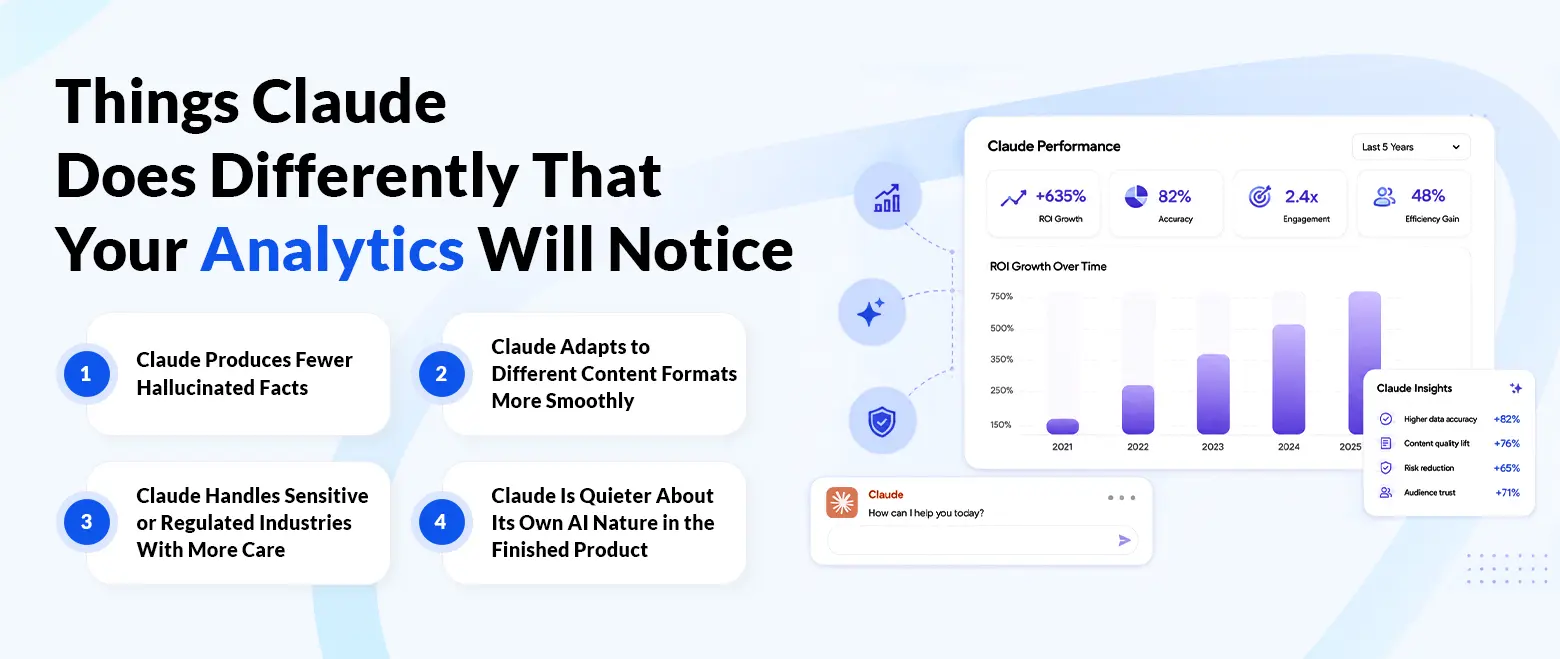
The quality shows up before the reader ever arrives. Here is what your analytics will start to reflect.
Hallucinated statistics and invented citations are a genuine risk with AI content tools. Claude is not perfect, but it is more conservative, meaning it is more likely to flag uncertainty than to invent a confident-sounding number.
For SEO content, where factual accuracy affects E-E-A-T signals, this conservatism is an advantage. When your content gets cited, shared, and/or reviewed, false facts can cause real damage to your brand’s credibility. Fewer hallucinations mean less time spent fact-checking and more confidence before you hit publish. That is a meaningful operational benefit for any team producing content at volume.
SEO content is not only blog posts. It includes landing pages, FAQ sections, product descriptions, resource guides and more. Claude moves between these formats cleanly, adjusting structure and tone without needing a completely different prompting approach for each one. ChatGPT requires more format-specific prompting to get comparable results.
For a growing business managing multiple content types across a website, this format flexibility reduces training time. It also speeds up production and keeps the overall content quality high regardless of what format a given week’s production schedule requires.
Many growing businesses operate in industries where content must be produced with care, such as financial services, healthcare, the law, and insurance. Claude is notably more thoughtful when handling these topics, producing content that is helpful without making claims that could create regulatory or liability problems. ChatGPT can produce content in these spaces, but it requires more careful prompting and more rigorous review.
For businesses in regulated industries, Claude’s default caution is a feature, not a limitation. It means first drafts are closer to publishable, and legal review is less of a recurring ordeal.
One of the telltale signs of AI content is the way it announces itself—with certain sentence patterns, structural tics, and a kind of relentless positivity that real human writers do not sustain. Claude produces fewer of these signals. The result reads more naturally, which matters both for reader trust and for AI-detection tools that some platforms, media outlets, and clients now use.
For a business where content credibility is part of the brand, the less your AI content reads like AI content, the better.
Knowing why Claude performs better is one thing. Here is what that actually looks like inside your day-to-day operation.
The biggest hidden cost in AI content is editorial labour. When first drafts require heavy reworking, the time savings of AI disappear quickly. Claude’s cleaner outputs reduce that editorial burden substantially.
Teams that have made the switch report that their editors spend more time on strategy and less time correcting awkward phrasing. That shift in how editorial energy is spent has a compounding effect—better strategy leads to better briefs, which leads to better outputs, which leads to better results across the entire content creation program.
If you manage content for clients, or if your internal stakeholders review content before publication, the quality of first drafts shapes their confidence in your editorial program. When drafts consistently come back needing significant work, confidence erodes; when they consistently come back polished and on brief, confidence builds. Claude’s output quality is a client relationship tool as much as it is a production tool. Growing businesses that invest in quality AI content find it easier to defend their content budgets when the results speak for themselves.
Scaling a content program is one of the hardest operational challenges a growing business faces. With Claude, the relationship between volume and quality does not have to be a trade-off. Because the tool follows briefs reliably and produces cleaner prose, you can increase output without a proportional increase in editorial overhead. That scalability is what makes Claude genuinely useful for a business that is growing—not just as a writing aid but as a core part of a content production system that can handle more without breaking.
Value is not just about the monthly subscription cost. It is about the total cost of producing one polished (and publishable) piece of content. When you factor in editing time, revision rounds, fact-checking, and the long-term performance of the content, Claude delivers better value for most growing businesses.
The tool that costs slightly less per month but requires twice the editing time is not actually cheaper. The one that produces content your team is proud of, that your audience trusts, and that search engines reward—that is the tool that earns its place in your budget.
Choosing the right AI tool for your content program is not about following the crowd. It is about finding the tool that fits how you work, what your readers expect, and what your rankings need. Claude vs. ChatGPT for SEO is a genuine comparison worth making, and for most growing businesses that have done it carefully, the choice has become clear. Claude produces content that is cleaner, more consistent, and more durable—and for businesses where content is a real investment, that difference adds up quickly.
For most growing businesses, yes. Claude produces cleaner prose, follows detailed briefs more reliably, and handles keyword integration more naturally—all of which contributes to content that performs better in search and requires less editing before publication.
Claude performs well in technical and regulated industries because it is more cautious about accuracy and less likely to fabricate statistics. It still requires good briefing and fact-checking, but first drafts in complex industries are typically more usable than those from other tools.
No AI tool guarantees undetected output, and chasing that goal is not a sound content strategy. Claude’s outputs tend to read more naturally than many tools, which reduces but does not eliminate detection signals. Focus on quality and accuracy rather than detection avoidance.
Write detailed briefs. Include your target keyword, secondary keywords, audience, tone, structure, word count and any internal links or calls to action. Claude follows instructions closely, so the more specific your brief, the stronger your output will be.
Claude works well at any scale. For small businesses producing two to four pieces of content per month, the reduced editing time is still an impactful benefit. For larger operations, the scalability and consistency advantages become even more distinct.
Underinvesting in their briefs. Businesses that copy their old ChatGPT prompts into Claude and expect different results are often disappointed. Claude rewards detailed, specific instructions—the more you put into your brief, the more it delivers on the other end.