
Running a small business means every dollar you spend and every hour you work counts. You cannot afford to pour money into marketing that does not bring customers through your door. Local search is one of the few channels where a small, consistent effort produces compounding results—and the best part is that (most of) it is free.
Most small business owners assume that SEO is something only big companies with big marketing departments can do. That is not true. The fundamentals are practical, learnable, and built for exactly the kind of business you are running right now.
Knowing how to improve local SEO is less about gaming an algorithm and more about clearly communicating to Google that your business is real, active, and genuinely useful to people in your area. That takes consistency, not a big budget.
Here we discuss tips for small businesses who are willing to learn how to improve their local SEO. Interested? Keep reading.
These tips work together, with each building on the last to create a strong local presence online.
Your Google Business Profile powers your appearance on Google Maps and in the local pack—i.e., the three listings that sit above all other search results. Go to business.google.com, claim your listing, and verify it by postcard or phone call. Fill every available field, like exact business name, local phone number, full address, website URL and operating hours including statutory holidays.
Select your primary category carefully. For instance, “Italian Restaurant” ranks differently than “Restaurant.” Upload at least ten real photos of your storefront, interior, team and products. You also have to write a description that names your city and specific services. For instance, “family dental clinic offering cleanings and Invisalign in Kelowna, BC” earns far more trust than a generic tagline ever will.
NAP stands for Name, Address, and Phone Number. Google cross-references these details across every directory where your business appears. Even a small mismatch—”Avenue” on your website versus “Ave.” on Yelp—creates a data conflict that damages your local rankings. Start by Googling your business name and noting every directory that surfaces. Then audit each listing using BrightLocal or Moz Local to catch any inconsistencies. Correct them one by one, standardizing your format across Yelp, Yellow Pages, Apple Maps and Foursquare. Update every listing immediately whenever your address, phone number or hours change. Outdated citations do not just confuse Google—they direct real customers to the wrong location or a disconnected phone number.
Google weighs four things when evaluating your reviews: total count, average star rating, recency and whether you respond.
A business that collects two or three reviews per month consistently will outrank one that collected thirty reviews two years ago and stopped. The most reliable way to build review volume is to send a follow-up text immediately after completing a job. Be sure to include a direct link to your Google review page. Tools like NiceJob or Birdeye automate this affordably.
Respond to every review within 48 hours. For negative reviews, name the specific issue, offer a resolution and keep your tone calm. Vary your replies to positive reviews, as a personalized response signals to prospective customers that a real person is running this business.
Your website’s efforts to improve your local SEO become permanent. Unlike social media posts that disappear from feeds, optimized web pages keep ranking month after month. Start with your title tags. i.e., the clickable headlines that appear in search results. Every service page should follow the format: Service + City + Province. For instance, “Furnace Repair in Saskatoon, SK” consistently outperforms a generic “Heating Services” title.
If you serve multiple areas, build a dedicated page for each location rather than listing every city on one page, as Google ranks each page individually. Place your city name in your H1 heading, your opening paragraph, and your image alt text. Together, these placements give Google a precise picture of where you operate.
Publishing one genuinely useful blog post per month can meaningfully lift your local search visibility. The goal is to answer questions your community is already asking. For instance, a roofing company in Calgary could publish a blog titled “How to Prepare Your Roof for a Calgary Winter. That single post targets a local search phrase, demonstrates real expertise and gives local news sites a reason to link to it.
Use Google’s “People Also Ask” box or the free tool AnswerThePublic to find the exact questions people in your area are looking to get answered. Fresh content signals to Google that your website is active and maintained. A dormant site with no new content is treated as a lower-priority result over time.
More than 60% of local searches happen on a mobile phone, and Google ranks mobile performance as a direct signal. A page that takes five seconds or more to load on a phone loses most visitors before they read a single word. Run your site through Google’s PageSpeed Insights at pagespeed.web.dev—it scores your site out of 100 and lists exactly what to fix, from oversized images to render-blocking scripts. Compress every image before uploading using Squoosh or TinyPNG, both of which are free.
Test your site on an actual phone rather than a desktop browser’s mobile preview. Tap targets (a.k.a. ‘touch targets’) that look adequate on a screen are often too small to use comfortably in practice.
A backlink from a credible local source tells Google that your business genuinely belongs in the community it claims to serve.
Your local Chamber of Commerce maintains a member directory. Join it and ensure your listing includes a link to your website. Your town’s Business Improvement Association typically does the same.
If you sponsor a minor hockey team, a school fundraiser, or a neighbourhood event, ask the organizer to include your website URL—not just your business name—in their sponsor acknowledgment post. Pitch a real story to a local journalist, such as your business anniversary, a community initiative, or a useful local resource you have built. A single link from a local newspaper carries more ranking weight than fifty generic directory listings.
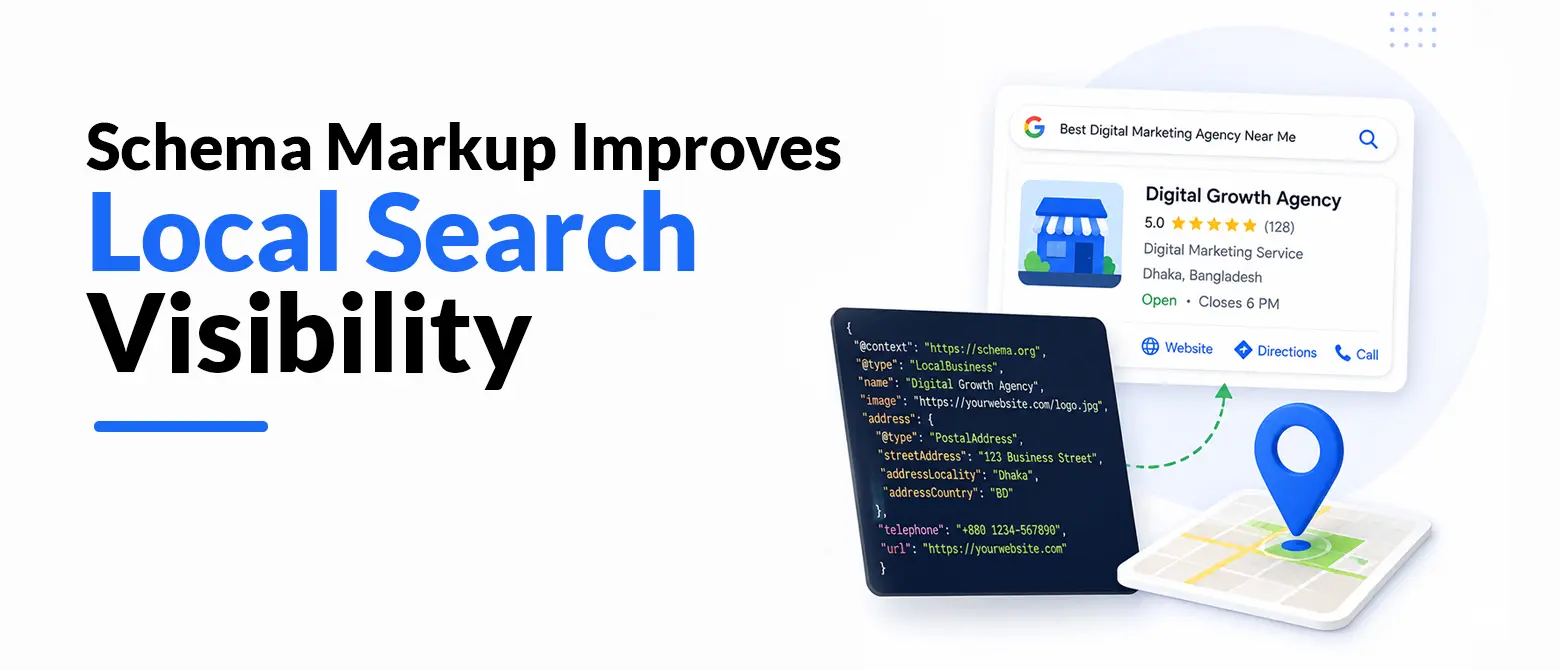
Schema markup is a small block of code that tells search engines the structured facts about your business—your name, address, phone number, hours, and service area—in a language they read directly rather than interpret. It is one of the most underused local SEO tips for small businesses because it sounds technical, but it is not.
Use Google’s free Structured Data Markup Helper at google.com/webmasters/markup-helper to generate the code without writing a single line yourself. Paste it into your website’s header. Once the schema is in place, Google can display your hours, star rating, and address directly in search results before anyone clicks. That extra detail increases your click-through rate and filters for customers who are already ready to call.
When someone uses Siri or Google Assistant to find a local business, they speak in full sentences—”Where can I get same-day physiotherapy in Ottawa?” rather than typing short phrases.
Your website needs to reflect that conversational pattern. Create a dedicated FAQ page that answers the most common questions your customers ask before booking, utilizing plain and direct language. Include your city name and service type naturally within each answer. Voice search results are overwhelmingly pulled from Google’s local pack which means your Google Business Profile completeness directly affects whether you appear in voice results at all. Pages that load quickly and answer a question in the first paragraph are the ones voice assistants read aloud to users.
You cannot improve what you are not measuring, and the tools you need are both free and user-friendly.
Google Search Console shows you which search queries are directing visitors to your website, which pages rank for those queries, and how your positions change over time. Set it up at search.google.com/search-console and check it monthly.
Your Google Business Profile dashboard shows how many people found your listing, whether they searched by name or by category, and what action they took, such as call, directions, or website visit.
If your direction requests are high but website clicks are low, that tells you that your profile is working but that your site needs attention. Each metric points to a specific next action rather than a general sense of how things are going.
Getting found is only half the job. These strategies make sure the people who find you actually pick up the phone and walk through your door.
Social media does not directly make an impact on your search ranking. However, it supports your local presence in ways that make sense. When you tag your location in posts, you show up in location-based searches within the platform. When local accounts share your content, you earn visibility with the exact audience you need.
Post at a consistent tone—three times per week is realistic for most small businesses—and use neighbourhood-specific hashtags. Engage with other local businesses by commenting on their posts genuinely. Celebrate community moments i.e., local events, seasonal changes in your city, or milestones in your neighbourhood. This positions your business as part of the local fabric rather than just another account broadcasting promotions.
There is a point when doing your own SEO stops being efficient and starts costing you more in missed opportunities than a professional would charge.
Reputable small business SEO services provide a full audit of your current local presence, identify the gaps that are holding back your rankings, and build a prioritized plan that fits your budget. Look for providers who show you real results from businesses who are similar to yours in terms of size and industry. Ask them specifically how they build local backlinks and how they handle citation cleanup, as these are the two areas where bad providers do real damage.
Any provider who guarantees a first-page ranking within 30 days is using shortcuts that Google will eventually penalize. Sustainable results take three to six months of honest and consistent work.
Your website can rank well in search and still fail to convert visitors if there is no clear instruction about what to do next. Every page on your site needs one specific call to action—not three competing ones. “Call us for a free estimate” is clear. “Book online in under two minutes” is clear. “Visit us at 123 Main Street, open Monday to Saturday” is clear.
Use a click-to-call button on every page so that mobile users can reach you with a single tap. Do not make them copy your number and dial manually. And place your phone number and hours in the header of your site, not just on the contact page. Most visitors never navigate to a contact page; the information needs to come to them.
Your Google Business Profile includes a public Q&A section that most business owners never check. Anyone—including people who have never visited your business—can post a question there, and if you do not answer it, a stranger might. Their answers may be inaccurate, outdated, or unhelpful.
Log into your profile weekly and answer every open question promptly and specifically. You can also post your own questions and answer them yourself. Think of the five things every customer asks before booking and address them proactively. Google indexes this Q&A content, which means your answers can appear directly in search results. A well-maintained Q&A section removes doubt among your customers and gives them the confidence to select you over a competitor they know less about.
Knowing how to improve local SEO does not need a huge budget or a technical background. It requires clarity about who you serve, consistency in how you show up online, and the discipline to check your numbers monthly. Start with your Google Business Profile, clean up your citations and build from there. Every step you take makes you easier to find for the customer who is already looking for exactly what you offer. You have built something worth finding. Now make sure the right people can find it!
Most small businesses see impactful ranking improvements within three to six months of consistent effort. Results depend on your local competition, how complete your Google Business Profile is and how regularly you collect reviews. Patience combined with monthly action produces the most reliable long-term growth.
A Google Business Profile alone can get you into local map results, but a website significantly strengthens your ranking potential. It gives Google additional content to evaluate and customers more reasons to trust and choose you over a competitor who has only a profile.
There is no fixed number. Recency and consistency matter as much as total count. Collecting two to three genuine reviews per month steadily will outperform a business that gathered thirty reviews two years ago and has not received one since. Always keep the momentum going.
Yes. Local SEO focuses on geographic relevance. It prioritizes your Google Business Profile, citation consistency, and location-specific content. Regular SEO targets broader national or global audiences and depends more heavily on domain authority and large-scale content production.
Yes, and many small business owners do. The core tasks like completing your profile, collecting reviews, fixing citations and writing location-specific content require time and consistency, not technical expertise. If results get stagnant after six months of honest effort, that is a reasonable point to bring in professional help.
That would be claiming and completing your Google Business Profile. It is free and directly feeds Google Maps and the local pack. An incomplete or unverified profile is the most common reason why a good local business does not appear when nearby customers are searching for exactly what it offers.