
 Perplexity
 ChatGPT
 Claude
 Gemini
 Grok
Every online marketing budget has a breaking point where it gets put to the test. Two paid platforms consistently come up in that conversation—Google and LinkedIn—and both have firmly earned their places in a serious marketing plan.
One is built on what people search for; the other is built on who people are professionally. That single difference creates entirely different advertising experiences, with different costs, different timelines, and very different results.
But the online marketing domain shifted heading into 2026. LinkedIn now captures 41% of total B2B paid media budgets, up from 37% in 2024, according to Dreamdata’s report. Google’s role has also shifted, as AI Overviews reshape top-of-funnel search behaviour. Both platforms continue to evolve, and older assumptions no longer hold.
Here we discuss Google Ads vs. LinkedIn Ads by comparing cost, lead quality, and ROI.
Google Ads vs. LinkedIn Ads: The Core Differences Explained
Let’s look at what truly sets these two platforms apart, from your budget and your pipeline, starting with the fundamentals.
1. What Is the Main Difference Between Google Ads and LinkedIn Ads for Lead Generation?
The answer to this question lies in how each platform thinks about your buyer and where they sit in the decision process.
Google Ads operate on intent. When someone types a keyword into a search bar, it means they are actively looking for a solution right now. LinkedIn Ads operate on identity. You define your ideal buyer by their job title, company size, industry, and seniority. Then your ad reaches that person whether they are searching or not.
Google captures existing demand. LinkedIn creates demand before someone knows they have a need. That fundamental distinction shapes every other comparison in this article.
2. Which Is More Expensive: Google Ads or LinkedIn Ads?
Looking at click costs alone gives you an incomplete picture of what each platform actually costs to run.
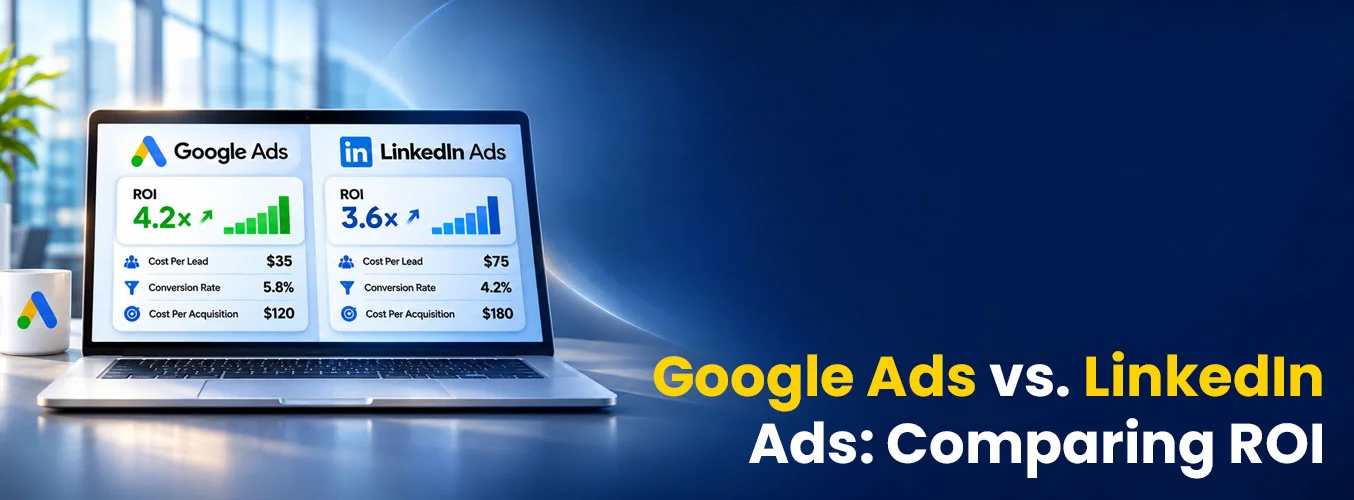
LinkedIn carries a higher cost per click. In 2026, LinkedIn’s average CPC for Sponsored Content sits between $6 and $16 across most B2B verticals, with competitive C-suite audiences pushing $15 to $25. Google Ads averages $2 to $5 per click across most B2B categories, though competitive verticals like software and financial services regularly push $10 to $15.
That upfront cost gap is real. But a cheaper click only saves money if the person clicking is your buyer. That is where the two platforms diverge most sharply.
3. How Do Conversion Rates Compare Between Google Ads and LinkedIn Ads?
Conversion rate tells you how efficiently each platform turns a click into an actual lead and the gap is wider than most advertisers expect.
Google Search campaigns typically convert at 2% to 5% on an external landing page, depending on industry and offer. LinkedIn’s native Lead Gen Forms convert at 6.1% on average in 2026, largely because they pre-fill using a member’s verified profile data. That removes the friction of a separate form entirely.
For campaigns where the barrier to conversion matters as much as the cost per click, LinkedIn’s on-platform experience consistently produces stronger form completion rates across most B2B verticals.
4. Which Delivers a Lower Cost Per Lead: Google Ads or LinkedIn Ads?
The cost per lead comparison shifts hugely once you account for conversion rates along with click prices.
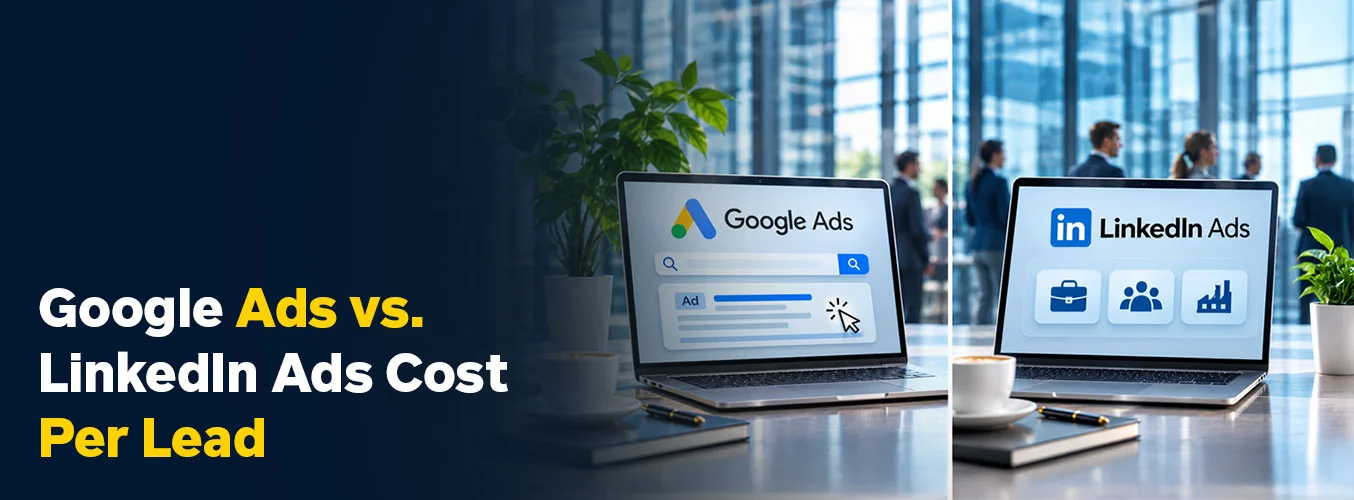
Google typically delivers a lower raw cost per lead because its clicks are cheaper. WordStream’s 2025 data puts the average B2B cost per lead on Google Ads at $70.11, up just 5% year over year. LinkedIn’s higher CPC is offset in part by stronger on-platform conversion rates.
For enterprise campaigns targeting a defined professional persona, LinkedIn’s cost per qualified lead often matches or beats Google once downstream conversion rates and lead-to-close ratios are factored in. The right metric is not cost per lead in isolation but the cost per closed deal.
5. Which Offers Better ROI: Google Ads or LinkedIn Ads?
When measuring Google Ads vs. LinkedIn Ads on return on investment, the platform that wins depends on how long your sales cycle runs.
Dreamdata’s 2026 benchmarking data found LinkedIn delivering 121% ROAS compared to 67% for Google Search, based on first-party revenue attribution across B2B accounts. However, the average B2B buyer journey runs 272 days from first impression to closed revenue. Measuring LinkedIn on a 30-day window consistently undercounts its contribution. Google’s ROI shows up faster which makes it stronger for shorter sales cycles and transactional categories.
For enterprise-level deals with longer timelines, LinkedIn’s pipeline contribution often proves larger once full-journey attribution is applied.
6. What Ad Formats Do Google Ads and LinkedIn Ads Offer?
The format your ad appears in shapes how your message lands, and each platform gives you a very different toolkit to work with.
Google Ads offers Search ads, Display ads, Performance Max campaigns, YouTube ads and Shopping ads. For B2B, Search ads remain the workhorse since they catch buyers mid-query. LinkedIn Ads offers Sponsored Content, Sponsored Messaging, Dynamic Ads, Text Ads and native Lead Gen Forms. Sponsored Content runs directly in the professional feed, while Message Ads land in a member’s LinkedIn inbox. LinkedIn’s Lead Gen Forms are particularly strong for B2B advertising campaigns because they pre-fill using a member’s profile data, removing the friction of a separate landing page entirely.
7. Which Platform Is Better for Reaching Decision-Makers?
When your ad needs to land in front of the person who signs the check, platform choice matters more than budget.
LinkedIn holds a structural advantage. With over one billion members sharing verified professional data, you can target a VP of Finance at a mid sized firm with a single parameter set. Google allows demographic overlays but cannot confirm that someone clicking your ad holds purchasing authority.
Industry data for 2026 shows that 89% of B2B marketers utilize LinkedIn for lead generation and 40% rate it the most effective channel for quality leads. That adoption reflects LinkedIn’s ability to surface leads from people who hold real purchasing authority within their organizations.
8. How Does Attribution Work on Google Ads vs. LinkedIn Ads?
Measuring the performance metrics, conversion events, or user actions on each platform is just as important as running the right campaign, and the two platforms measure success very differently.
Google Ads offers multiple attribution models, including last-click, data-driven and time-decay. Data-driven attribution is now the default and distributes credit across all touchpoints that contributed to a conversion. LinkedIn’s Revenue Attribution Report connects ad impressions and engagements to closed revenue using CRM data which makes it possible to see which campaigns influenced the pipeline directly.
See What the Right Digital Marketing Strategy Could Do for Your Business
Because B2B buyer journeys average 272 days, short attribution windows on either platform will undercount real impact. Setting your measurement window to at least 90 days gives a far more accurate picture of what each platform is actually contributing.
9. How Much Budget Do You Need for Google Ads vs. LinkedIn Ads?
Practical budget floors for each platform are higher in 2026 than they were just two years ago.
Google Ads require roughly $1,500 to $2,000 per month to generate enough conversion data to optimize properly. LinkedIn requires between $4,000 and $5,000 per month for competitive B2B audiences, though its technical daily minimum is just $10 per campaign.
Most small to mid-sized B2B companies running LinkedIn effectively spend between $1,500 and $5,000 monthly. Below these thresholds, neither platform generates enough data to improve performance meaningfully.
If your budget cannot sustain a real test on both platforms simultaneously, pick one, run it well, and expand from there.
10. Which Platform Produces Leads Faster: Google Ads or LinkedIn Ads?
Timeline expectations vary considerably between platforms, and setting them correctly prevents premature campaign decisions.
Google Ads moves faster. With a properly configured campaign targeting search intent, leads can arrive within 15 to 30 days once Smart Bidding clears its learning phase. LinkedIn takes longer. Most B2B advertising campaigns see first impactful results, including demos and qualified leads, within one to three months. Pipeline impact typically takes three to six months to materialize.
LinkedIn users are consuming professional content and not actively searching for a product or service to buy. Repeated exposure builds the trust that drives action. If you need leads this quarter, Google is the faster engine.
11. Should You Use Google Ads or LinkedIn Ads for High-Ticket Services?
The price of your service changes the math on which platform can justify its cost. For high-ticket services with average contract values above $20,000, LinkedIn consistently justifies its higher costs. At that deal size, one closed client can return the entire month’s ad spend many times over.
Comparing Google Ads to LinkedIn Ads at this price point makes the math understandable. A $150 LinkedIn lead that closes to a $50,000 contract outperforms twenty $30 Google leads that stall after a first call. Professional services firms, enterprise SaaS companies and custom development agencies tend to see the strongest pipeline returns from LinkedIn’s precision.
12. Can Google Ads and LinkedIn Ads Be Used Together?
The most productive paid strategies treat these platforms as partners in the same funnel, not competitors for the same budget. LinkedIn builds awareness and trust among the right professional personas early in the buying cycle. Google captures those same buyers later, when they are actively researching and comparing vendors.
LinkedIn’s Matched Audiences feature also lets you retarget website visitors and upload CRM contact lists, creating a bridge between both platforms. For high search volume categories, starting with a 60% Google/40% LinkedIn budget split is a reasonable baseline. Adjust as your sales cycle length and deal economics become clearer over time.
13. Google Ads vs. LinkedIn Ads: Which Should Your Business Choose?
The right platform depends on who you need to reach, how long your sales cycle runs, and what your average deal is worth.
If your buyers are actively searching for your category, your deals close within weeks and your CPCs are manageable, Google Ads is the right starting point. If your buyers fit a specific professional profile, your contracts are high-value and your sales cycle runs months, LinkedIn Ads will serve you better.
For most growing B2B businesses, the more productive question is not which platform to choose but how to split the budget between them as revenue scales. Start with the platform that fits your immediate need, prove the return, then expand.
Comparing Google Ads and LinkedIn Ads is less about picking a winner and more about matching the right platform to your business needs right away Google rewards active search intent with speed and volume. On the other hand, LinkedIn rewards professional precision with lead quality and long-term pipeline value. The strongest paid strategies use both together with each doing the job it does best across different stages of the buyer’s journey. At G Web Pro, we help businesses build paid advertising approaches grounded in authentic data and easy-to-understand business objectives. The goal is precise targeting that brings the right conversations directly to your sales team. When the strategy fits the business, the results follow naturally.