

 Perplexity
 ChatGPT
 Claude
 Gemini
 Grok
If your website rankings moved this week, you are not alone. A major algorithm change started rolling out on November 10, 2026, and it is affecting search results in every country and across every language on Google.
The timing makes this harder than most. This rollout may still be active when Black Friday arrives on November 27. That means ranking changes and seasonal traffic shifts are showing up in your data at the same time.
Rewriting pages or removing content right now is one of the worst reactions you can have. Google is very clear on this: wait for the full rollout to finish before making any significant changes to your website.
Here, we discuss the Google November 2026 Core Update through a practical SEO checklist that tells website owners exactly what to do and when.
What the Google November 2026 Core Update Means for Your Site Right Now
During the Google November 2026 Core Update rollout, the right move is to record what is happening, rule out unrelated causes, and avoid reacting to numbers that are still changing every day.
1. What Should You Annotate Right Now in Search Console?
Adding an annotation in Google Search Console and GA4 for November 10, 2026, takes about two minutes and will save you a lot of confusion months down the road. When you check your performance charts in February, that annotation tells you exactly why the line moved. Export the Search Console Performance report for the full week of November 3 to 9, the week before the update began. This is your pre-update baseline. Save clicks, impressions, average position, and your top 50 pages and queries. Store it somewhere you can retrieve it quickly when you are ready to compare.
2. How Do You Know If a Drop Is Technical or Algorithmic?
A drop that starts the same week as an algorithm change is not always caused by the algorithm. Open Search Console and check the Manual Actions and Security Issues reports first. Both can cause ranking declines without any advance warning.
Next, check Page Indexing for a spike in Excluded by noindex. A plugin update can accidentally add a noindex tag to an entire page template, removing those pages from search results with no visible sign. Also check your GA4 tag. If analytics dropped but Search Console clicks held steady, the problem is your tracking setup, not Google.
3. How Do You Separate Algorithm Shifts From Black Friday Seasonality?
This update may still be active when the holiday shopping season peaks. Organic traffic often changes in late November for reasons that have nothing to do with rankings. The ideal way to separate the two is to compare the same dates from last year in the Search Console.
Check Google Trends for your main queries to see if demand itself has shifted. Compare branded and non-branded searches separately. If non-branded impressions dropped but branded clicks stayed steady, that is a ranking issue. If both moved in the same direction at the same time, seasonality is the more likely explanation.
4. Is It a Good Idea to Rewrite Pages While a Rollout Is Active?
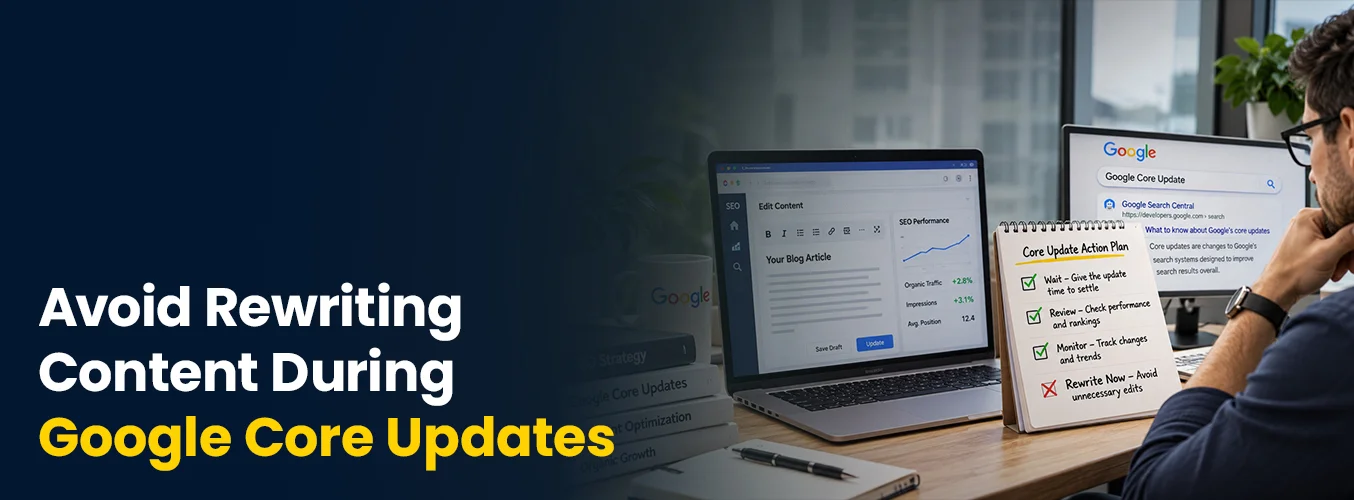
Google advises against making large-scale content changes in direct response to early ranking movements. During any active rollout, positions can shift several times in a single week. A page you rewrite on day three gets evaluated on the new version, not the version that ranked before. That makes it much harder to understand what actually caused the original change.
The only content work worth doing right now is fixing genuine technical problems like broken pages, indexing errors, or a compromised site. For any page whose decline has no obvious technical explanation, monitor and document, but keep your hands off content that is currently still performing.
5. Which Pages Should You Track Most Closely During a Core Update?
A site-wide drop looks alarming, but it rarely shows you what matters most. Focus on the pages tied to real business outcomes like leads, sales, and high-intent traffic.
An SEO checklist for website owners should start with the pages that directly affect revenue and not the ones that just pull in casual readers. In Search Console, go to the Pages tab, filter by your top 10 to 15 URLs and track clicks and impressions daily. A concentrated drop in one content type tells a very different story than a spread-out decline. The former points to a specific problem; the latter suggests something broader.
After the Google November 2026 Core Update: How to Read What Changed
Once the Google November 2026 Core Update rollout is complete and at least one full week has passed, the data becomes reliable enough to show you what shifted, by how much and in which part of your site.
1. What Is the Right Comparison Window to Use in Search Console?
Google recommends waiting at least one full week after a core update finishes before drawing any conclusions. This particular update is expected to end around November 24, which puts the ideal analysis window at December 1 or later.
Compare a full post-update week against the November 3 to 9 baseline you saved earlier. For instance, avoid comparing your Black Friday week data against a normal early-November week. Retail traffic peaks heavily during the holiday period for reasons that have nothing to do with rankings. Mixing those two windows produces misleading numbers even when nothing ranking-related has actually changed.
2. Why Should You Use the Search Type Filter in Your Performance Report?
This filter is one of the most overlooked tools in Search Console after a core update. At the top of the Performance report, switch Search Type from Web to Image, Video, and News separately and compare. A drop in Image search is a completely different problem from a drop in Web search, and each requires a different response.
See What the Right Digital Marketing Strategy Could Do for Your Business
For service businesses, review the Rich Results report to confirm that your FAQ schema or structured data is still displaying correctly. Many website owners attribute a decline to a ranking change when the real issue is a snippet format that stopped showing up.
3. How Do You Find a Pattern in the Pages That Dropped?
In the Pages tab of Search Console, sort by the click difference between your pre-update baseline and your post-update week. You are not looking for a list of dropped pages. You are looking for a pattern. Did the drops concentrate on blog posts, product pages, or service pages? A pattern tells you something real about how Google is reassessing your content. A spread-out decline with no visible pattern is harder to diagnose and may point to a site-wide quality signal rather than a page-level issue. That distinction matters most when you are deciding where to put your time and what to fix first.
4. What Does Google’s October 2026 Content Update Mean for the Pages That Dropped?
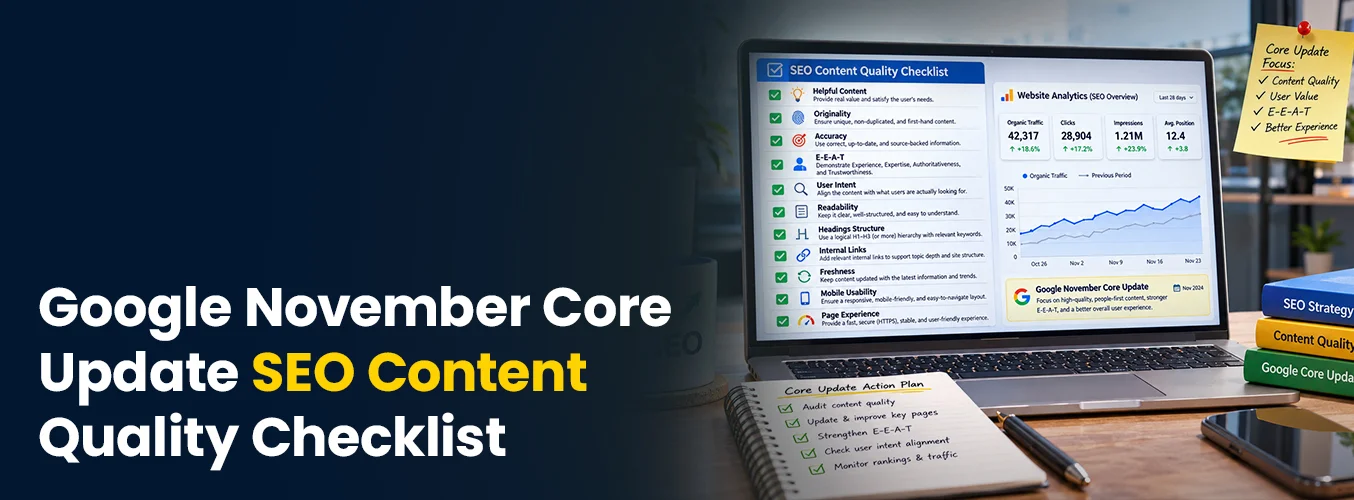
Google updated its Helpful Content guidance in October 2026 to include four signals: effort, originality, skill or talent, and accuracy. For each page that dropped, ask a few honest questions:
- Does the page add something not already in the top results, such as your own data, a tested approach, or a real example?
- Would a reader trust the person behind this content on the topic?
- Was the publish date updated without any real change to what is below it?
Pages that summarize publicly available information without original perspective are more likely to lose ground in updates like this.
Beyond the Google November 2026 Core Update: Habits That Keep Your Rankings Stable
The sites that hold their ground through algorithm changes are not simply responding well after the fact. They are following consistent practices that build quality into the site itself and long before any update rolls out.
1. Why Do Authorship and Credibility Signals Matter More After This Update?
Google’s October 2026 guidance specifically calls out deceptive authorship as a quality problem. This includes invented authors, false credentials and uncredited AI-generated content.
For each of your commercially important pages, you should ask whether a real, qualified person is visibly credited. Add author bios with genuine credentials on key content pages. If AI helped you draft something, disclose that process and show that a knowledgeable person checked every claim.
Google is not penalizing AI-assisted content outright. It is looking for content that a real person with real knowledge stands behind. That signal is harder to fake and easier to build when it is genuine.
2. What Does Running a Site Crawl After a Core Update Reveal?
Core updates sometimes reveal structural issues Google had already been quietly deprioritizing. After a core update, run a site crawl using a tool like Screaming Frog or Sitebulb. Look for orphan pages with no internal links pointing to them, broken internal links, and pages with very thin content. Identify your most important pillar content and confirm it is linked to frequently from related pages. A well-linked page tells Google it matters to your site’s topical coverage. Poor internal linking can suppress pages that would otherwise rank well on content quality alone, with no warning before or after an update.
3. How Does a Monthly SEO Habit Change the Way You Handle Core Updates?
Most website owners only review their SEO when something breaks. By then, the problem has often been there for weeks.
A solid Google core update SEO checklist is not just for emergencies. Running through it monthly takes about 20 minutes: check Search Console for manual action notices, review impressions and clicks on top pages, and confirm key pages are still indexed.
Sites that monitor consistently know their baseline already. So, when the next update rolls out, they are not scrambling to figure out what was normal. They already know, which makes the analysis faster and the response far more accurate.
The Google November 2026 Core Update is not the last one. Google runs two to three core updates per year. Each one rewards the same things i.e., accurate, original content from credible people, on a site that is technically clean. Choose an expert digital marketing agency that works with Canadian businesses to build that kind of digital foundation, one that holds through algorithm changes rather than scrambling after each one. If your rankings moved this week, start with the data and not with fear. Document, compare and act only when the evidence is obvious.