
Your business’s reputation is no longer built slowly over years of handshakes and word of mouth. It is shaped in seconds, by strangers, on platforms you may not even monitor. A single review, be it honest or not, can decide whether a new customer calls you or your competitor.
The rules governing those reviews have changed dramatically. Regulators are no longer just watching; they are acting. In October 2024, the U.S. Federal Trade Commission’s Consumer Review Rule took full effect, and by December 2025 the agency had already sent warning letters to ten companies for potential violations. Penalties can reach USD 53,088 per violation, and that figure is expected to rise with inflation adjustments in 2026.
Canadian businesses are not immune. Where American regulatory momentum goes, Canadian consumer protection conversations tend to follow, and many businesses operating across both markets face dual scrutiny. Staying informed is not optional. It is a basic cost of doing business online today.
Here we will talk about online reputation management and compliance with review disclosure regulations in 2026 to help you protect your business, build genuine trust, and avoid costly regulatory mistakes.
TABLE OF CONTENTS
Understanding the rules is the first step. Applying them consistently is where most businesses fall short. Here is a detailed look at the seven core areas where online reputation management compliance requires your full attention.
Before you can follow the rules, you need to know what they forbid. The FTC’s Consumer Review Rule makes it clearly illegal to create, purchase, or share fake reviews—meaning reviews from people who never actually used your product or service. It also bans buying positive reviews outright, even if you frame the offer as a contest or reward.
The rule prohibits suppressing negative reviews, meaning you cannot filter your review feed to show only five-star feedback while burying honest criticism. Businesses that use third-party “review gating” tools—software that prevents unhappy customers from reaching a public review platform—are directly in violation.
You cannot operate a website that looks like an independent review source but is actually controlled by your company. These are not grey areas. They are firm prohibitions, and the FTC has stated plainly that enforcement actions and civil penalties are on the table for businesses that ignore them. Getting familiar with the full text of 16 C.F.R. Part 465 is genuinely worth your time, or, at minimum, sharing it with your marketing and legal teams for review.
This is the area where well-meaning businesses most often get themselves into trouble. If an employee, manager, officer, or their immediate family member writes a review of your business, that relationship must be clearly disclosed. The FTC rule (Section 465.5) is specific: it is not enough to quietly hope the reviewer adds a note. Management has an active responsibility to instruct anyone they have solicited for reviews to include a clear, conspicuous disclosure of their connection to the company.
For instance, a star rating with a small asterisk buried at the bottom of a page does not meet this standard. The disclosure needs to be visible, upfront, and plain enough that a casual reader would immediately understand that the reviewer has a personal connection to the business. Failure to manage this actively—not just passively—exposes officers and managers to direct liability.
If you ask employees to encourage their relatives to leave reviews, you are also responsible for ensuring those family members disclose the relationship. The chain of accountability runs further than most business owners expect.
Giving customers an incentive to leave a review is not automatically illegal. However, tying that incentive to a positive sentiment is a clear violation of the review disclosure regulations’ 2026 compliance standards. The difference matters. Saying “leave us a review and receive 10% off your next order” is permissible—provided you also disclose that an incentive was offered. Saying “tell us how much you loved our product and get 10% off” implies a positive outcome is required, which is explicitly prohibited.
Even if your phrasing seems neutral, the FTC has motioned that implied conditions count. If a reasonable person reading your review request could infer that a negative review would not earn the reward, you are in violation. The safest approach is to word all incentive requests in a way that makes it obvious any honest review qualifies. Then prominently disclose that an incentive was offered alongside every review generated through such a programme. Document your programme carefully, keep copies of all solicitation language and review it regularly against current guidelines.
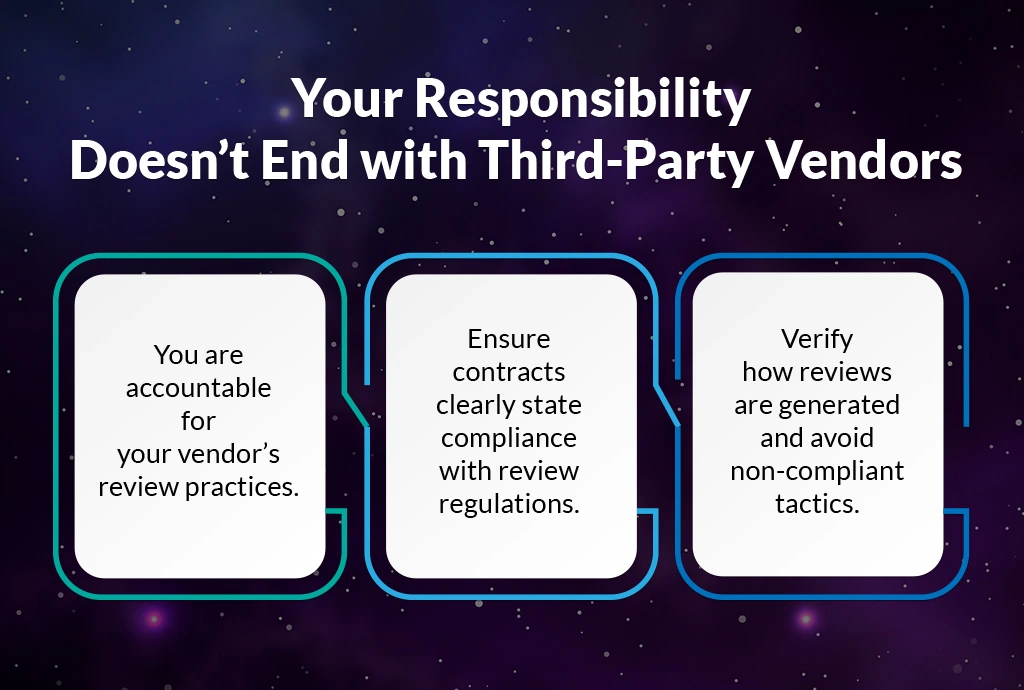
Many businesses outsource their review management to marketing agencies, reputation firms, or software platforms. This is a good strategy in many ways, but it does not transfer your legal responsibility. If the agency you hire is using prohibited tactics like fake reviews, gating tools, or undisclosed incentives, you can still face enforcement action. The FTC has made it clear that businesses are accountable for the practices of the vendors they employ.
As part of a sound reputation management strategy for businesses, every contract with a third-party vendor should include explicitly written commitments that their practices comply with the Consumer Review Rule and relevant platform policies (Google, Yelp, Trustpilot, and others all have their own guidelines).
Ask vendors directly how they generate reviews and request documentation. If they cannot explain their process clearly or seem evasive about how reviews are sourced, that is a serious red flag. Do not assume compliance. Always verify it and put that verification in writing.
Review management best practices in 2026 are not just about legal compliance. They are also about showing customers and regulators alike that your business operates with integrity.
Responding to negative reviews fast and professionally is one of the proper signals you can send. Research consistently shows that most consumers expect a response to a negative review within a week, yet most businesses fail to meet that expectation.
When you respond, acknowledge the concern, keep your tone calm and warm, and offer a constructive path forward. Do not threaten the reviewer, offer to remove the review in exchange for compensation, or attempt to intimidate them into changing their feedback. All three of those actions are prohibited.
A respectful reply to a negative review can improve your reputation more than a library of five-star ratings. It demonstrates that you are a real business run by people who take their customers seriously, and in a world where consumers are increasingly skeptical of overly polished online reputations, that authenticity carries real weight.
Online reputation management compliance is not a one time audit. It is an ongoing practice. Platforms change their policies. New reviews appear daily. Mentions of your brand surface across social media, forums, and news aggregators in real time. A business that is not actively monitoring its digital footprint cannot reasonably claim to be managing it.
Set up Google Alerts for your brand name, key product names, and your executives’ names. Use a dedicated reputation monitoring tool to track reviews across Google, Yelp, BBB, industry-specific directories, and social platforms. For multi-location businesses, this is especially critical, as a pattern of unaddressed complaints at one location can damage the entire brand.
Monitoring gives you early warning of potential compliance issues. For example, if a vendor is generating suspicious review spikes, you want to catch that before a regulator does. A simple reputation dashboard that consolidates your average star rating, new mentions, and sentiment trends across channels is an affordable starting point for businesses of any size.
When baked into how your business operates, honest practices are the most durable way to meet the legal requirements for reviews in 2026. When compliance stops being a checklist and becomes second nature, you will stop worrying about violations and start focusing on the trust you are building.
That starts with asking for reviews the right way. Reach out to actual customers after a genuine transaction, keep your request neutral, make it easy to leave feedback on multiple platforms, and disclose any incentive clearly.
For instance, a simple follow-up email after a purchase saying “we’d love to hear what you think; your honest feedback helps us improve” with a direct link to your Google or Trustpilot profile is both compliant and effective. Train your customer service, marketing, and sales teams on what they can and cannot say when requesting reviews. Make sure no one in your organization is “review shopping,” i.e., contacting only satisfied customers while skipping over those who may have had a neutral or negative experience.
Authentic review collection, done consistently, produces a more realistic and trustworthy body of feedback than any shortcut, and it keeps you firmly on the right side of the rules.
Knowing about the rules is one thing. Putting them into practice every single day is where most businesses either build their edge or lag behind.
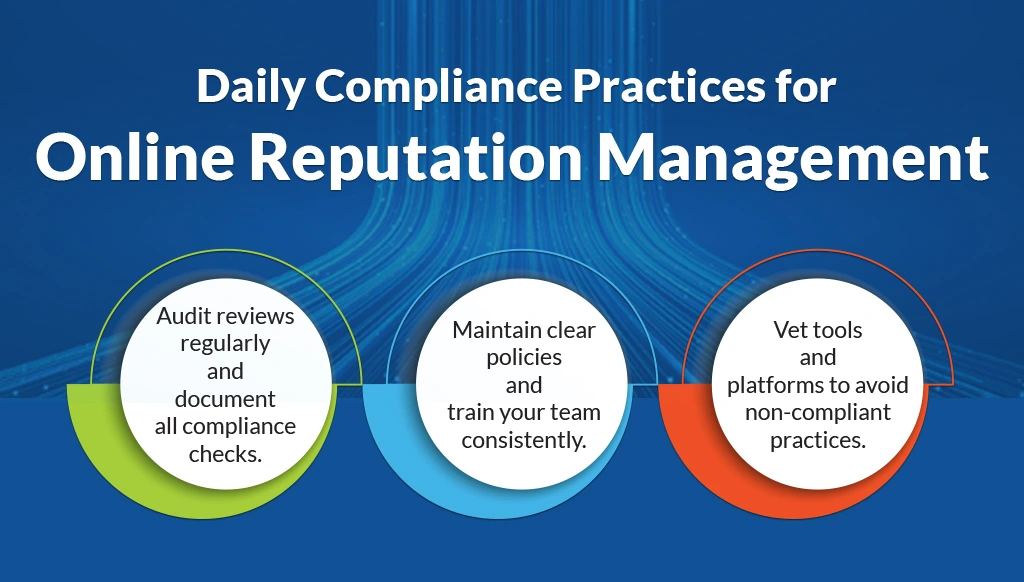
Set aside time every three months to inspect how reviews are being collected, displayed, and replied to across all platforms. Check that no incentivized reviews are missing their disclosures, that no insider reviews have been posted without proper identification, and that your response rate to negative feedback is where it should be.
Document what you find and what you changed. This record becomes valuable evidence of good faith compliance if questions are ever raised.
Every business that actively manages its online reputation needs a written internal policy covering review solicitation, insider disclosure requirements, vendor standards, and prohibited practices. This does not need to be a lengthy legal document. It needs to be clear, practical, and accessible to the people who actually send review requests and respond to customer feedback. Review and update this document at least once a year, or whenever major regulatory changes occur.
Policies on paper mean little if the people executing your review strategy have not been trained on them. A short, practical training session for marketing, sales, and customer service teams covering what they can ask for, how to word requests, what to disclose, and what is prohibited goes a long way toward preventing unintentional violations.
This is especially important when onboarding new staff or working with seasonal employees who may not be familiar with your standards.
New software tools for reputation management appear all the time. Before adopting any new platform or tool, research how it works. Does it use gating mechanisms that filter negative reviewers before they reach a public platform? Does it promise to generate reviews through methods that are not clearly tied to genuine customer transactions?
If a tool’s pitch involves boosting your star rating through methods it cannot explain plainly, walk away. The short-term gain is not worth the regulatory and reputational risk.
Compliance protects you from penalties, but a well-built reputation management strategy for businesses is what turns that protection into lasting customer trust and real business growth.
Transparency is the foundation of a sound reputation management strategy for businesses in 2026. When customers see that your reviews reflect a mix of experiences that are mostly positive, occasionally critical, but always real, they trust the picture far more than a feed of identical five-star testimonials.
Disclose what needs to be disclosed and acknowledge shortcomings honestly. Consumers are increasingly good at spotting manufactured reputations, and the damage from being caught is far greater than the occasional negative review you were hoping to hide.
A critical review is not just a problem to be managed; it is data. Patterns of negative feedback often point to genuine operational issues. This includes slow delivery, confusing product descriptions, and gaps in customer service. Businesses that take this feedback seriously and act on it improve both their customer experience and their review scores organically with time.
Moreover, responding to negative reviews publicly and then following up to show what changed is one of the most credible reputation-building moves available to any business.
Not every review platform requires equal attention. A restaurant must focus on Google and Yelp. A software company should monitor G2 and Capterra. A healthcare provider needs to keep an eye on Healthgrades.
Spreading your efforts evenly across every platform dilutes your focus. Check the two or three platforms where your target customers are likely to research your business and invest your monitoring and response efforts there first.
Online reputation management compliance is not a standalone project for the marketing department. It touches customer service, operations, legal, HR, and leadership. Businesses that treat it as a company-wide responsibility rather than a task assigned to one person tend to do it more consistently and more effectively. Build it into quarterly business reviews, tie it to customer satisfaction metrics, and make it a regular conversation at the leadership level.
The rules around online reviews have changed from suggestions to enforceable standards, and the businesses that adapt to it the earliest will be in the strongest place. Compelling online reputation management compliance in 2026 is not complicated. It asks for honesty, consistency, and a willingness to treat your customers’ feedback as something worth respecting. The businesses that gain authentic trust over time will always outperform those that try to manufacture it. Start with the basics: train your team, audit your vendors, and let real customer experiences speak for your brand.
The FTC Consumer Review Rule effective October 2024 prohibits fake reviews, undisclosed incentives, and suppression of negative feedback. Canadian businesses operating in the U.S markets or on U.S.-facing platforms are expected to comply, and similar standards are reflected in Canadian consumer protection law.
You can offer an incentive for leaving any honest review—positive or negative—if the request is sentiment neutral and the incentive is clearly disclosed alongside the review. You cannot make the reward conditional on a positive outcome or a specific star rating.
It means the disclosure must be placed where a reader will actually see it—not buried in fine print, footnotes, or a separate page. It should be written in plain language, positioned near the review itself, and immediately understandable to an average reader with no legal background.
Review gating refers to filtering customers before they reach a public review platform; for instance, asking satisfied customers to post publicly while directing unhappy ones to a private feedback form. This distorts the public picture of your business and is a direct violation of the Consumer Review Rule.
Any review from an employee, officer, manager, or their immediate relatives must clearly disclose the reviewer’s relationship to the business. Management has an active responsibility to instruct these individuals on the disclosure requirement before soliciting their reviews.
Opt for vendors who can explain their review generation process properly and transparently, who do not use gating tools or fake review sourcing, who comply with platform-specific policies (like Google, Yelp, and Trustpilot) and who are willing to put their compliance commitments in writing inside your service contract.