
Starting an online store is an exciting step for any business owner, and one of the first and most important choices
you will make is selecting the right platform. This decision affects how your store looks, works, and grows over time.
Two of the most popular options are WordPress and Shopify. Both platforms are widely used and trusted by businesses
around the world. However, they work in very different ways, and each has its own strengths and limits. Some people
prefer full control over their website, while others want a simple setup that works quickly. Your preference depends
on your goals, budget, and technical comfort level.
In this post, you will learn about WordPress vs Shopify and which one you should choose for your e-commerce store.
TABLE OF CONTENTS
Before choosing a platform, it is important to understand how they work and what makes them different. This helps you pick the one that suits your needs.
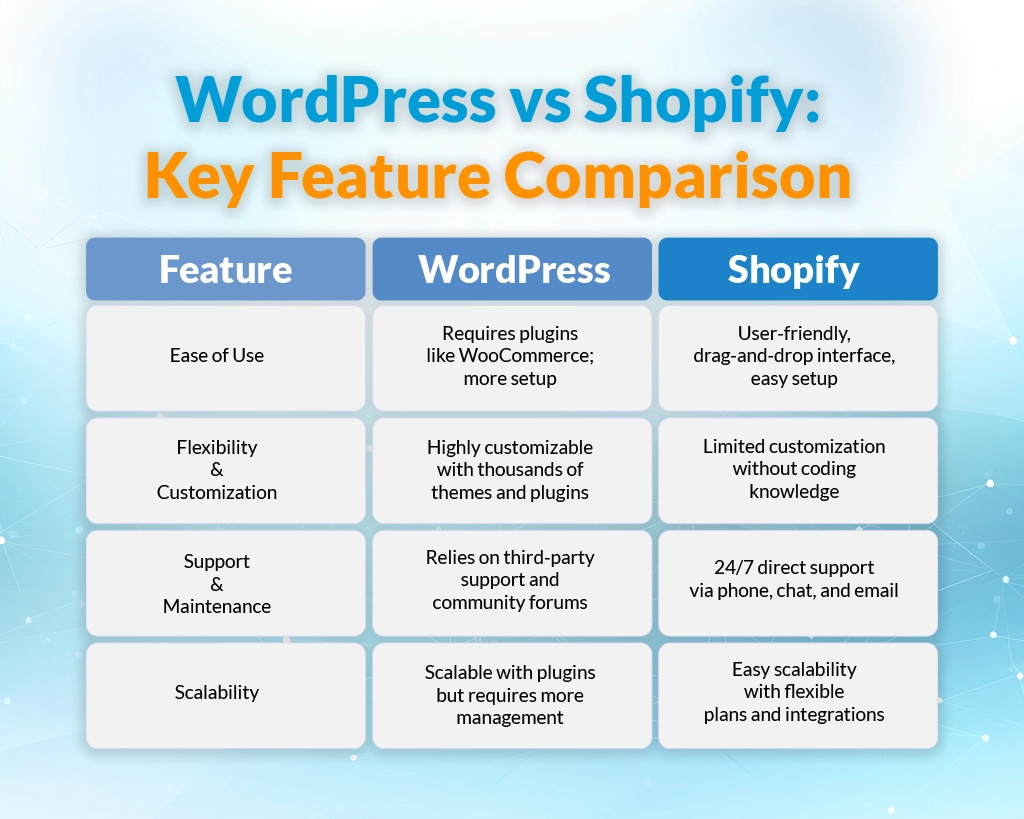
When selecting and comparing different e-commerce platforms, ease of use is a deciding factor. Shopify is known for its user-friendly design. It is built with e-commerce in mind and requires minimal technical knowledge. The platform provides a drag-and-drop interface, so you can easily set up your store, add products, and customize the look without needing to know how to code.
WordPress, on the other hand, requires a little bit more effort to get started. While it’s a powerful platform, setting up an e-commerce store on WordPress usually requires installing a plugin like WooCommerce. Although the process is straightforward, WordPress does require some learning, especially if you plan on customizing your site deeply.
Conclusion: For beginners, Shopify for e-commerce is the better option for ease of use. If you’re someone who enjoys having complete control and is comfortable with some technical setup, WordPress might be the way to go.
One of the biggest reasons businesses choose WordPress is its level of flexibility. With WordPress, you can build virtually any type of website or online store thanks to its thousands of themes and plugins. Whether you are running a small boutique or a large marketplace, WordPress offers a range of customization options to suit your needs.
Shopify is a bit more restrictive when it comes to personalization. While it provides different themes and apps, the platform is created to make the process easy and restricts deeper customization unless you have coding knowledge. Shopify’s structure is highly focused on getting your store up and running quickly, but it is less flexible for businesses that need advanced, bespoke features.
Conclusion: If your first need is flexibility and you want total control over your store’s design and features, WordPress is likely the better option. However, if you want to streamline the process and don’t mind a more structured setup, Shopify works well.
Shopify offers various pricing plans, starting from $49/month and going up to $517/month. These plans include hosting, SSL certificates, and other essential e-commerce features. While the upfront cost is clear, additional fees may apply for apps, themes, and third-party integrations, which could increase costs.
WordPress itself is free, but to run a store you need to pay for hosting, a domain, and a premium theme. You will also need to pay for plugins like WooCommerce for the e-commerce functionality. On average, setting up a WordPress e-commerce store might cost more upfront due to hosting and additional paid themes or plugins. However, with WordPress, you have more control over costs and can select the services that fit your budget.
Conclusion: If you prefer an all-in-one solution with clear pricing, Shopify might be the better choice than WordPress. But if you are on a tight budget and don’t mind spending time managing different services, WordPress can be more cost-effective in the long run. Therefore, when comparing WordPress vs Shopify for online stores, it all boils down to your needs.
When running an online store, you need reliable customer support. Shopify shines in this category with 24/7 support via phone, chat, and email. They also have an extensive knowledge base and community forums where you can find answers to most questions. This makes it an excellent choice for businesses that need quick help without technical expertise.
WordPress relies heavily on the support of third-party services like hosting providers and plugin developers. While there is a massive community of WordPress users and developers online, the support isn’t as direct or consistent as Shopify’s. You may find yourself troubleshooting or relying on forums for help.
Conclusion: If customer support is a priority, Shopify is the winner. Its all-in-one platform ensures that you have help available whenever you need it.
Both WordPress and Shopify offer scalability but in different ways. Shopify is designed for businesses that want to scale quickly. As your business develops, you can upgrade your plan easily to release additional features like advanced analytics, shipping options, and more. Shopify also integrates with a variety of apps, making it easy to add new functionality as your business expands.
WordPress also offers scalability, but you may need to rely on third party plugins or custom development to accommodate your business’s growth. The open source nature of WordPress allows for almost unlimited scalability, but it may require more work to manage as your store becomes larger and more complex.
Conclusion: If you are looking for a platform that can grow with your business with minimal effort, Shopify may be the better choice. However, if you want total control over your site’s growth and don’t mind managing the technical side of things, WordPress is a great option.
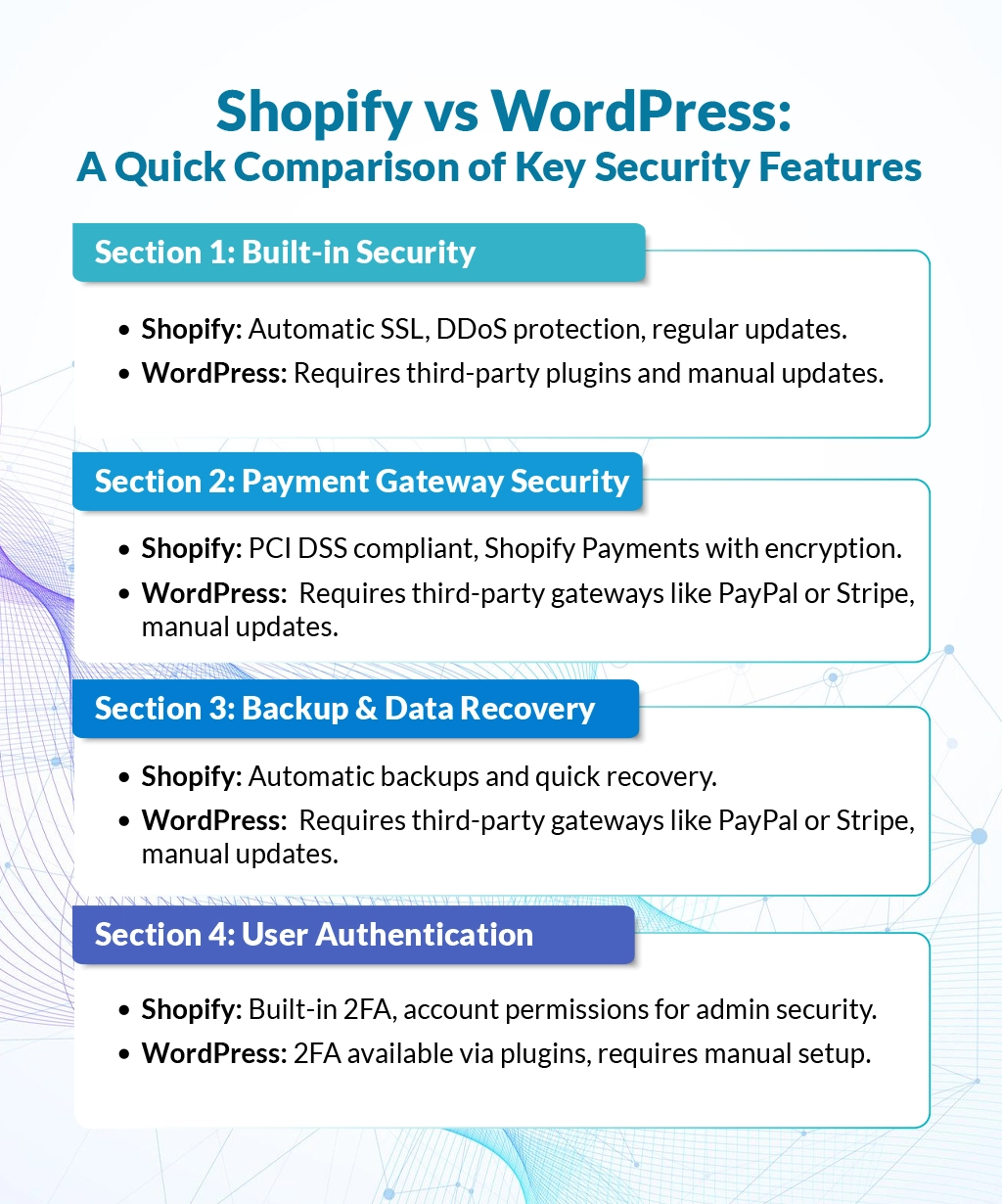
Security is a major concern for any e-commerce store owner. You want to ensure your customers’ data is protected and that your store remains operational without being compromised. Let’s look at how Shopify and WordPress handle security.
Shopify provides strong security features as part of its all-in-one platform. It involves an SSL certificate for secure transactions, protection against DDoS attacks, and regular software updates. Shopify automatically makes sure that your store is safe, reducing the chances of security issues affecting your business.
WordPress, being an open-source platform, offers flexibility but also requires more effort from store owners to maintain security. You will need to add third-party security plugins and regularly update themes and plugins to prevent vulnerabilities. While WordPress can be highly secure, it requires more hands-on management.
Conclusion: Shopify wins when it comes to built-in security features, especially for users who prefer not to worry about maintaining security themselves.
Both Shopify and WordPress (via WooCommerce) offer secure payment gateway integrations. Shopify supports numerous payment processors, including its own Shopify Payments, which provides additional layers of security. With Shopify Payments, you get PCI DSS compliance and encryption without having to manage third-party services.
For WordPress stores using WooCommerce, you’ll need to incorporate third party payment gateways like PayPal, Stripe, or others. While these payment gateways also provide secure transactions, you will need to manage and maintain security plugins and updates manually.
Conclusion: Shopify offers more convenience and assurance in payment security, while WordPress gives you flexibility but requires additional effort.
Shopify handles data backups automatically. Since it is a hosted solution, Shopify takes care of data recovery and backup on its end. In the event of an issue, Shopify can quickly restore your store without much intervention from your side.
On WordPress, backup solutions are not automatically included. You’ll need to rely on plugins or third-party services to back up your store’s data. Regular backups are crucial for WordPress stores, as they can be more vulnerable to hacking or data loss without a solid backup plan.
Conclusion: For ease of use and peace of mind, Shopify’s automatic backups make it a better option for those who don’t want to manage backups themselves.
Shopify comes with built-in user authentication and password security features to keep your admin panel safe. The platform supports two-factor authentication (2FA) to protect your account from unauthorized access. Shopify also offers features like account permissions, making sure you can control who has access to various parts of your store.
With WordPress, you can enable 2FA and other security measures through plugins. However, since WordPress is more customizable, it’s up to you to ensure your account security features are properly set up and maintained.
Conclusion: If you’re looking for a platform that takes care of user authentication with minimal setup, Shopify is the clear winner. However, WordPress can be just as secure if you take the necessary precautions.
Let’s dive into some key e-commerce features offered by both platforms. These are the functionalities that can directly affect your day-to-day operations and customer experience.
Shopify makes product management incredibly easy. You can add products in bulk, arrange them into categories, and manage stock levels flawlessly. Shopify also offers automatic inventory updates and integrates with shipping services for easy order fulfillment. It’s all designed to make inventory management simple and efficient.
WordPress, through WooCommerce, provides product management tools that are fairly robust, but they require more setup and customization. WooCommerce lets you manage inventory, set stock limits, and track orders, but you may need to install additional plugins for more complex product management features./p>
Conclusion: For straightforward, easy-to-use inventory management, Shopify has the edge. If you have more complex needs or prefer greater flexibility, WordPress can offer more customization options.
Both platforms provide tools to help you rank higher on search engines, but their approach is different. Shopify is SEO-friendly out of the box, with automatic URL structuring, meta tags, and SEO-friendly templates. However, for advanced SEO features, you may need to install additional apps, which can cost extra.
WordPress offers more advanced SEO capabilities through plugins like Yoast SEO or RankMath. These plugins allow you to optimize titles, descriptions, and content with ease. WordPress also gives you greater control over technical SEO elements, which is an advantage for businesses looking to implement advanced strategies.
Conclusion: For robust and customizable SEO, WordPress has more to offer. Shopify is simpler and easier for beginners but might not have the depth needed for more advanced SEO strategies.
Mobile optimization is important for e-commerce stores set up nowadays. Both platforms are mobile friendly, but Shopify’s mobile responsiveness is built into its themes. Shopify automatically makes sure your store looks great on any device, which makes it ideal for users who prioritize mobile shopping.
WordPress offers mobile optimization through responsive themes, but you may need to tweak settings or use plugins to ensure everything looks great on all devices. The flexibility of WordPress allows for more customization, but it also means more work.
Conclusion: If mobile optimization is a priority and you want things to work smoothly right away, Shopify has a clear advantage. WordPress provides flexibility but needs more work to get things just right.
Choosing between WordPress and Shopify for e-commerce depends on your needs. Shopify is perfect for those who want an easy, all-in-one solution with strong security and quick setup. WordPress, however, offers more flexibility and customization for those willing to manage technical aspects. Both platforms can help set up a successful online store, so consider factors like budget, technical expertise, and growth goals. Ultimately, the right choice will support your business now and in the future.
Shopify is easier to use for beginners due to its user friendly interface and built-in e-commerce tools. WordPress offers more customization but requires additional setup and plugins like WooCommerce, making it more suitable for those with technical expertise. Choosing an e-commerce platform practically depends on your requirements.
Yes, you can migrate from Shopify to WordPress. The process involves exporting your products, customer data, and orders from Shopify and importing them into WooCommerce on WordPress. It may need technical skills or professional assistance to make sure the transition is smooth.
Both Shopify and WordPress are mobile responsive. Shopify’s themes automatically adjust to mobile devices, providing a hassle-free experience. WordPress, through responsive themes, can also be mobile-optimized, but some customization may be required for optimal performance.
WordPress has a more robust SEO setup with plugins like Yoast SEO, allowing better control over your content and technical SEO. Shopify is SEO friendly but offers fewer customization options compared to WordPress for advanced SEO features.
Yes, Shopify includes hosting, SSL certificates, and security as part of its pricing plans. Being a fully hosted platform, Shopify handles all aspects of hosting, software updates, and security, letting you to focus on growing your store without technical concerns.
Both Shopify and WordPress allow third-party payment gateways. Shopify supports various gateways such as PayPal and Stripe, but using Shopify Payments offers lower fees. WordPress offers flexibility in incorporating any payment gateway through WooCommerce or other plugins.