
Toronto is one of the most competitive business cities in the world. With millions of consumers making purchasing decisions based on what they read online, what people say about your business has real consequences—on your revenue, your hiring, and your ability to grow.
One negative review left unaddressed can spiral quickly. One bad story picked up by a local blogger, one misleading social media post and customers you have never even met are already forming an opinion about your business. The damage can be fast and deeply unfair.
That is why online reputation management has become a core part of running a responsible, resilient company in Toronto. It protects what you have built and gives you a way to respond when things go sideways.
Let’s discuss the power of online reputation management and guidance on protecting your brand in Toronto’s competitive market.
Here are seven reasons why your online reputation deserves far more of your attention than it is probably getting right now.
Before a new customer walks through your door or places an order, they search. Most people searching for a local business in Toronto will read reviews before making any decision—this is simply how buying behaviour works now, across nearly every industry and age group.
For Toronto businesses operating in a dense, choice-rich market, this is not abstract—it is the moment your business is won or lost before anyone even speaks to you. What shows up in those first few search results carries enormous weight. If your Google profile shows a 3.1-star rating with several unanswered complaints, even the best service in the world does not get a chance to prove itself.
Online reputation management for Toronto businesses starts with understanding that your digital presence is your first handshake—and it has to be firm, warm, and trustworthy. Paying attention to what search results say about you—and actively working to shape that picture—is not vanity but good business.
Only one negative review is rarely the end of the world. However, leaving it without a response is where businesses get into trouble. When a frustrated customer posts a complaint and receives nothing but silence, they often escalate. They post on another platform, share their complaints on social media, or tell friends. Other potential customers reading that unanswered review draw their own conclusions—and those conclusions are rarely charitable.
Responding promptly, professionally, and with genuine care shows your entire audience—not just the upset customer—that you take accountability seriously. The response is often more important than the review itself. A well-handled complaint can increase consumer confidence because it proves that when something goes wrong, you show up. This is the basic principle of reputation management for businesses: turning a problem into proof that you are the kind of company people can count on.
This is the honest part that nobody really wants to hear. If you are not actively managing your online reputation, your competitors almost certainly are. Firms in Toronto’s professional services, hospitality, real estate, retail, and healthcare sectors are increasingly treating reputation as a competitive differentiator—and the ones doing it well are pulling ahead of those who are not.
For instance, two dental clinics on the same street, with similar prices and qualifications, will not compete equally if one has 200 glowing reviews and a thoughtful digital presence while the other has 12 reviews and a two-year-old website. The brand protection services offered by Toronto-based consultants are designed to help businesses close that gap—or stay ahead of it entirely.
Knowing what your competitors’ reputations look like online and where you stand by comparison is data you should have. It should inform your marketing, your customer service training, and your content strategy.
Most business owners focus entirely on customer-facing reputation—and understandably so.
But your reputation as an employer matters just as much if you want to attract talented people in a tight labour market. Toronto’s job seekers use platforms like Glassdoor and Indeed to read reviews from former and current employees before accepting offers. If your workplace culture comes across as dismissive or chaotic in those reviews, your hiring pipeline narrows noticeably.
A poor employer reputation cues deeper operational problems to potential clients and partners. After all, people talk and industries are smaller than they appear. A proactive reputation strategy includes monitoring what employees say about your company and creating internal conditions worth writing home about. Online reputation management for Toronto businesses, if done right, works from the inside out.
Your Google Business Profile rating is not just a vanity metric—it directly affects where you show up in local search results.
Review count, score, and recency are all factors in how local businesses are ranked in search results—making your review profile a direct input into your local SEO performance. A business with consistent, fresh, positive reviews is more likely to appear in the coveted local map pack that dominates search results for queries like ‘best accountant in North York’ or ‘plumber near Leslieville’.
This means that the online reputation repair services that Toronto businesses sometimes need is also, in effect, an SEO recovery project. Your responses to reviews signal to Google that your profile is actively managed, which improves ranking. Every review, good or bad, is an opportunity to add relevant, natural language to your profile—language that reinforces what your business does and where it does it. Reputation and local visibility are not separate strategies.

Nobody launches a business expecting a crisis. But crises do happen—a product recall, a viral social media post taken out of context, a dispute with a disgruntled former employee that goes public, a data breach.
Without having a plan in place before any of these things happen, your response will be reactive, slow, and potentially damaging. The businesses that weather crises well are usually the ones that have already thought through the scenarios, identified who speaks on behalf of the company, and established relationships with their community that carry enough trust to survive a rough patch.
Toronto online reputation repair firms specialize in this kind of preparation and recovery. But the best time to call them is before anything goes wrong, not in the middle of a storm. A reputation management plan is like insurance: you hope you never need it, but you are genuinely glad it exists when you do.
Waiting for happy customers to leave reviews on their own is a slow strategy. The truth is that people who have had a great experience rarely think to post about it unless someone asks them to. Meanwhile, someone who had a frustrating experience often feels compelled to write immediately. This natural imbalance means that businesses with no active review strategy end up with a skewed online picture that does not reflect reality.
The solution is simple but requires consistency: ask. Follow up after a purchase, a service call, or a project completion. Make it easy—send a direct link, keep the request short, and thank people sincerely for their time. Use the positive reviews you collect as social proof on your website, in email campaigns, and across your social platforms.
This is core to reputation management for businesses of any size. You do not just manage what people say—you create the conditions for them to say something good.
Before trouble finds you, these four building blocks will make sure your business is already standing on solid ground.
If you have not claimed your Google Business Profile, your Yelp listing, your Facebook page, and any industry-specific directory where your business might appear, do it today. Unclaimed profiles can be edited by the public, may display outdated information, and send a quiet signal that nobody is home.
Brand protection services provided by Toronto consultants often start here, by doing a full audit of every place your business name appears online and making sure those profiles are accurate, complete, and reflect your brand. This is the unglamorous foundation of a solid reputation strategy, and it matters enormously.
You cannot respond to what you do not know about. Set up Google Alerts for your business name, your key staff members’ names, and any product or service names you are known for. Social listening tools can flag mentions across platforms in near real-time.
For a local business, even one mention in a neighbourhood Facebook group can gain traction fast. Knowing about it early gives you the chance to respond before the conversation runs away from you.
This is not costly, takes thirty minutes to set up, and pays for itself the first time it surfaces something important before it becomes a problem.
Responding to every review from scratch is time-consuming and leads to inconsistent messaging. Create a small library of response templates—for positive reviews, for neutral reviews, and for critical ones—that reflect your brand voice and can be personalized quickly.
A thoughtful, on-brand response takes three minutes when you have a template to start from. Without one, it is easy to put off a response, and delays in responding to negative reviews are one of the most common and costly reputational mistakes that Toronto businesses make.
Before anything goes sideways, decide who in your organization has the authority and the training to speak publicly. This might be you, a communications lead or a trusted PR professional.
The worst crisis responses come from companies where multiple people are posting contradictory things, or where no one responds at all because everyone assumes someone else is handling it.
A clear internal protocol—who speaks, on what platforms, with what approval process—is one of the most practical and underused tools in a reputation protection plan.
Beyond damage control, here are four habits that quietly build a reputation strong enough to outlast any rough patch.
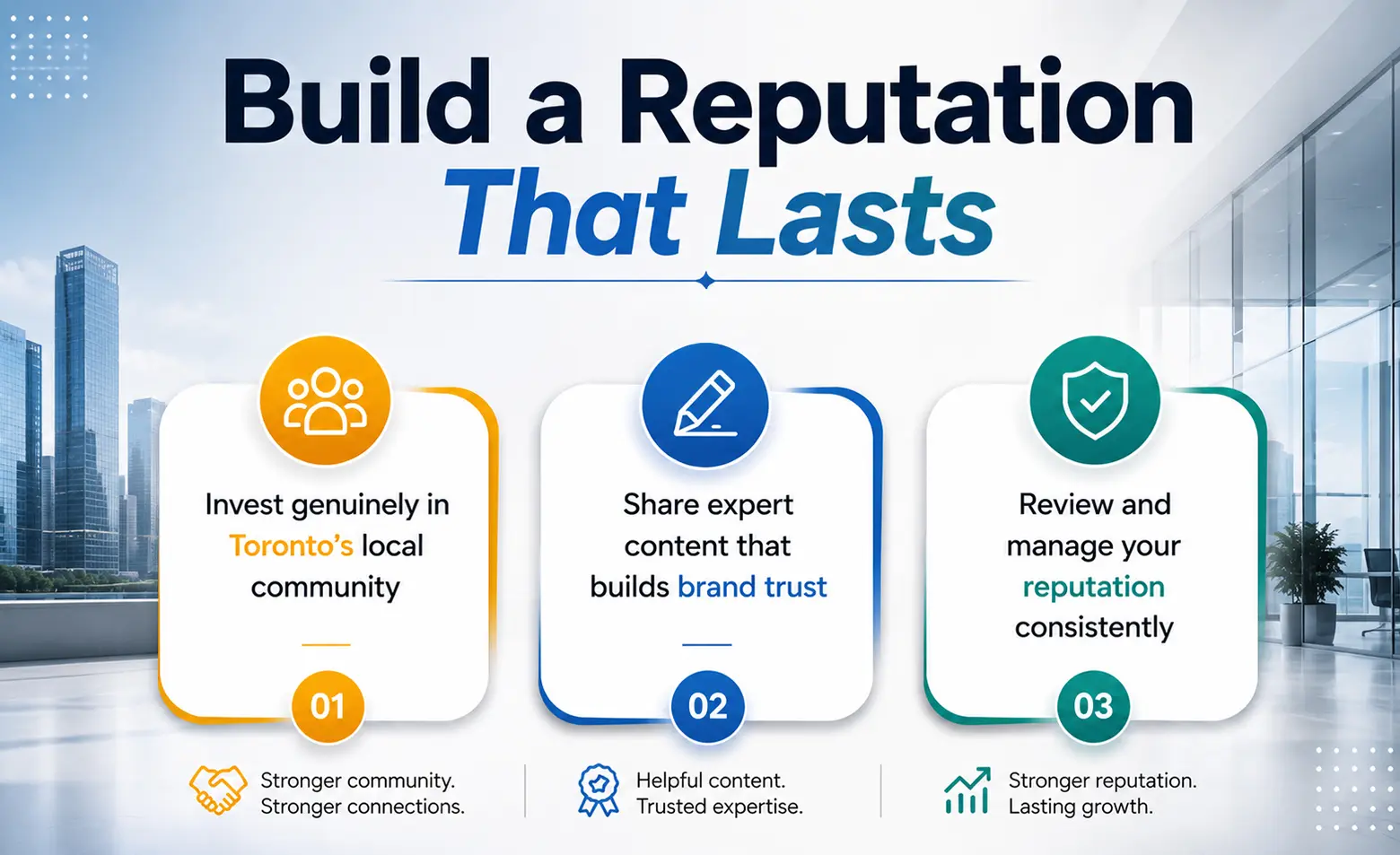
Toronto’s consumers are sophisticated and value-driven. They notice when a business is genuinely involved in the community versus when it is engaging in involvement for optics. Sponsor a local event because you believe in it, or partner with a neighbourhood organization that lines up with your values. Show up consistently over the years, and not only during a PR moment.
This kind of authentic community presence builds the goodwill that cushions your reputation when bumps occur. Online reputation management works best for Toronto businesses when it is predicated on real relationships, not manufactured ones.
A business blog, a LinkedIn presence, or a YouTube channel where you share genuinely useful knowledge does two things at once:
When someone searches your company name, you want more than just review sites to appear. Content you control gives you the chance to tell your own story in your own words—to show the values, the expertise, and the personality behind the business. This is long-term reputation building through consistency and generosity.
When a customer is unhappy and reaches out through a public channel, your first goal should be to move the conversation to a private channel—a phone call, a direct message, or an email.
This is not about hiding anything; it is about giving the person the genuine, focused attention they deserve. Public comment threads are poor environments for resolving real problems. When you handle complaints with care, and they are genuinely resolved, many customers will update their review or delete it entirely.
Set a calendar reminder every three months to do a personal audit.
This habit of regular self-review keeps you grounded in reality and ensures that small problems are caught before they become structural ones. The businesses in Toronto with the strongest reputations are not lucky—they are paying attention, consistently and without ego, to the picture the world sees.
Your reputation is, in many ways, the most valuable thing your business owns. It took years to build, it influences every customer interaction, and it lives online now, whether you tend to or not. Investing in online reputation management for Toronto businesses is not about fear. It is about respect for what you have built and a clear-eyed commitment to protecting it. Start with the basics, stay consistent, and respond to people with the warmth and honesty that good businesses are made of. Your name is worth it.
Most businesses begin to see quantifiable improvements within three to six months of consistent effort. This includes responding to reviews, encouraging new ones and publishing relevant content. Patience and consistency matter a lot more than any single tactic.
Not at all. Small and mid-sized Toronto businesses benefit enormously from reputation management. Many of the most effective strategies—claiming profiles, responding to reviews, and setting up monitoring alerts—cost little or nothing to implement with basic guidance.
Document it with a screenshot first. Then respond professionally without becoming defensive. Most platforms have a flagging process for reviews that violate their policies. If the review is genuinely defamatory, consult a legal professional about your options alongside a reputation specialist.
Yes, recovery is possible, though it takes time and sustained effort. Businesses that acknowledge what happened, make genuine changes, and communicate transparently with their community tend to rebuild trust. Reputational crises that are handled with honesty are often remembered less harshly than those that are stonewalled.
Very important. Responding to positive reviews shows appreciation, reinforces your brand’s warmth, and signals to future readers that a real person is behind the business. It also encourages other satisfied customers to leave reviews when they see their peers acknowledged.
For basic monitoring and review responses, many businesses manage well in-house with clear processes. For complex situations such as ongoing negative press, a reputation crisis, or competitive SEO challenges, working with Toronto brand protection service professionals can make a meaningful difference in the speed of their results and the outcome.