
Your website is doing more work than you might think. It answers questions before your team picks up the phone, builds trust before a handshake happens, and either wins a potential client’s confidence or quietly loses it in a few seconds. A site that looks good but does not reflect your actual business goals is a missed opportunity that costs you money.
Most business owners understand this. That is why choosing who builds your site is so important. The fear of wasting your budget or, worse, ending up with a website you are embarrassed to share is completely valid. You deserve to feel confident in your choice of web design company.
The good news is that finding the right candidate is not random. There are practical, concrete things you can look for, ask about, and measure before you sign any contract.
Here we will discuss how to find a web design company that aligns with your business goals to help you make a clear-headed, confident choice that pays off for years to come.
TABLE OF CONTENTS
Use these seven criteria as your practical checklist. Each reveals something different about whether an agency is genuinely built to serve your business.
Before reaching out to a single agency, be honest with yourself about what you need. A good web design company will ask about your goals before they ever talk about colours or layouts, but you need to have answers to their questions. Do you want your website to generate more leads, sell products online, build credibility in a new market, or reduce the volume of support calls you receive? Each of these requires a different approach to structure, content, and user flow.
Vague goals produce vague results. If you walk into a discovery call saying, “We just want a better website,” you will likely receive a generic solution. Instead, aim to define two or three specific outcomes. For instance, “We want to increase consultation bookings by 30% within six months” gives a design team something real to plan around. This kind of clarity protects your investment and sets a fair standard for measuring success.
An agency’s portfolio tells a richer story than most people realize. Yes, the visual quality of the website matters. But what you are really looking for is evidence that their past work solved real business problems. Look at sites they have built in industries similar to yours, or for companies at a similar stage of growth. Pay attention to whether their portfolio includes work that is recent, ideally within the past two years.
Web standards shift quickly, and a portfolio full of five-year-old projects does not tell you much about where they are today. Ask them directly: what did the client need, what did you build, and what changed as a result? Agencies that do strong, business-aligned web design will have concrete answers to these questions. They will talk about conversion rates, lead quality, and measurable outcomes, not just aesthetic choices. If a company can only say “the client loved it,” that is not enough information.
Any web design company worth your time will have a formal discovery process before a single pixel gets placed. This is the phase where they ask about your audience, competition, existing traffic, and brand positioning. If an agency jumps straight to showing you templates or talking timelines without asking substantive questions first, that is a red flag worth noting.
A genuine discovery process typically covers your target customer, the problems your site needs to solve, the journey a visitor should take, from landing page to conversion, and any technical requirements. For instance, a company with custom e-commerce needs has very different requirements than a professional services firm looking to book consultations. An agency that asks the same surface-level questions for every client is not really doing strategy—they are doing order-taking, and there is a significant difference in what you will receive at the end.
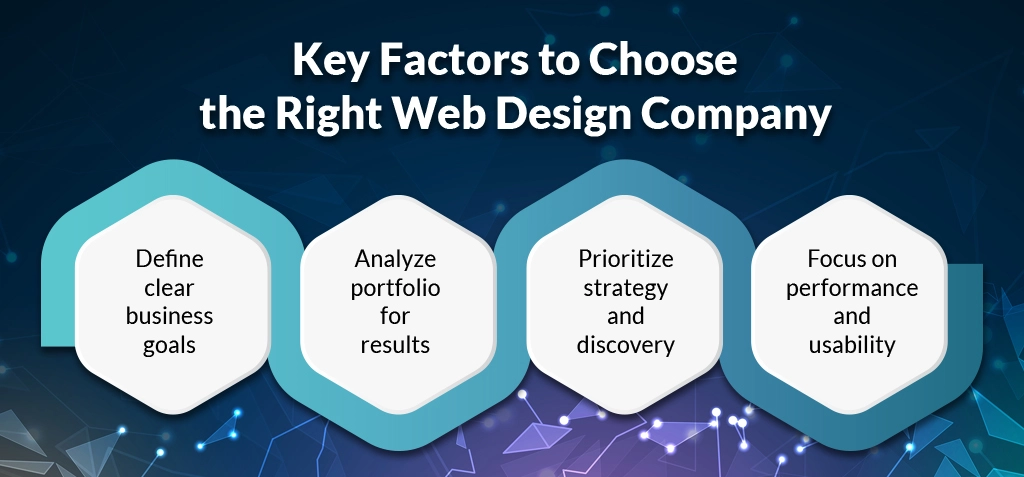
A beautiful site that loads slowly, ranks nowhere in search results, and confuses visitors into leaving is not a success but an expensive problem. Web design services that are worth the investment build with performance baked in from the start. Ask potential agencies how they handle page speed, mobile responsiveness, and search engine optimization. These should not be afterthoughts or add-ons. They should be part of how the agency thinks about every design decision from day one.
Ask to see examples of sites they have built that perform well technically, not just visually. Tools like Google’s PageSpeed Insights are publicly available, and a good agency will not shy away from showing you their work tested against real metrics. If they cannot explain how their design choices support your visibility online, you are likely looking at a vendor rather than a strategic partner.
How a company communicates during the sales process is a strong preview of how they will communicate during the project. Do they respond promptly? Do they listen to what you are saying, or do they steer every conversation back to their preferred solutions? Do they explain things clearly without talking down to you?
Ask specifically about their project management process. Will you have a dedicated point of contact? How often will you receive updates? What tools do they use to manage feedback and revisions?
Business-aligned web design is a collaborative process that does not happen in isolation. You should expect to be involved at meaningful stages, not simply handed a finished product and asked for approval. For instance, agencies that use tools like shared project boards or video walkthroughs tend to produce fewer surprises and fewer rounds of costly revisions at the end.
Web design costs vary enormously, and comparing quotes without understanding them is a fast way to make a poor decision. A low quote that excludes copywriting, SEO setup, or post-launch support may end up costing far more than a higher quote that includes those things. Ask every agency you speak with to walk you through exactly what is and is not included in their pricing. Also, ask about ongoing support after the site launches.
Your website is not a one-time project. It needs updates, security patches, and occasional improvements as your business evolves. Understanding the full cost of ownership, not just the upfront build cost, helps you make a fair comparison. The goal of choosing a web design company should never be to find the cheapest option. It should be to find the option that delivers the most useful result for a fair and transparent price.
Online reviews on platforms like Google or Clutch can surface patterns that a polished sales presentation will not show you. Look for consistent comments about communication, honesty, timeliness, and whether clients felt the agency genuinely cared about their results.
Do not be shy about asking for references. A confident, experienced web design company will happily connect you with past clients who can speak to their experience. When you speak with those references, ask about what the process felt like, not just the final product. Did the agency stay on budget? Were there surprises? Did they feel heard throughout? How has the site performed since launch? These conversations give you a ground-level view that no proposal document can replicate, and they are one of the most valuable steps you can take before committing to a significant investment.
Knowing what to avoid is just as useful as knowing what to look for. These four warning signs are worth watching closely before you commit.
If an agency is ready to give you a quote before they understand your business, your audience, or your goals, that is a sign they are selling a product rather than solving a problem.
Good web design services are built around strategy first. An agency that leads with price before asking meaningful questions is not the right partner for web design for business growth.
Pretty screenshots are not evidence of success. If an agency cannot speak to how their work performed in terms of traffic, leads, or conversions, they may be skilled at visual design but not at building sites that do real work for a business. Ask for case studies with numbers, not just testimonials with kind words.
Templates have their place, but if every site an agency has built looks essentially the same, they are probably not thinking hard about what makes your business distinct. Choosing a web design company that customizes its approach to your specific audience, industry, and goals will always produce better long-term results than one pushing a standard package.
Some agencies are very focused on getting you to the finish line of launch day and are less interested in what happens after.
But a website needs ongoing attention, content updates, performance monitoring, and periodic improvements as your goals shift. If an agency does not have a clear answer about what post-launch support looks like, plan accordingly.
That first conversation is your best opportunity to assess fit. These four questions will tell you more than any proposal ever will.
This question tells you immediately whether the agency is serious about understanding your business before building anything. A thorough discovery process is the foundation of business-aligned web design. If they do not have a clear, structured answer, that tells you something important.
You want to see relevant experience, not just impressive work in general. A company that has built sites in your industry or for your type of audience will understand nuances that a generalist might miss. Ask them to walk you through a specific project and explain the decisions they made.
This question separates agencies that care about outcomes from agencies that care about deliverables. The right answer should reference specific metrics, like traffic, conversion rate, lead volume, or another measurable indicator tied to your goals.
Understand exactly what the post-launch relationship looks like. Will they be available for updates? Is there a support plan? What is the process for requesting changes? This question protects you from finding out too late that the relationship effectively ended on launch day.
Finding the right web design company is less about finding the flashiest portfolio and more about finding a team that genuinely wants to understand your business. The best partnerships are built on clear communication, honest expectations, and a shared commitment to results. Take your time, ask the right questions, and trust the process, because a website that truly works for your goals is one of the best investments you can make. If you are ready to work with a team that leads with strategy and builds with your growth in mind, G Web Pro would love to hear about your project. Reach out today for a no-pressure consultation.
Costs vary widely depending on complexity, but most professional business websites range from $5,000 to $30,000 or more. Focus on value and what is included, not the lowest number. A clear scope of work helps you compare quotes accurately.
A well-built, custom business website usually takes eight to sixteen weeks from discovery to launch. Complex projects with custom functionality or large amounts of content can take longer. Timelines should be confirmed clearly in your project agreement before work begins.
A freelance designer typically handles visual design alone, while an agency brings a team covering strategy, design, development, and often SEO. For businesses with growth goals, an agency’s broader skill set usually produces more complete and effective results.
Ask to see portfolio examples from your industry and ask them to explain the decisions they made for those clients. An agency that has worked in your space will ask sharper questions about your audience and will not need basic explanations of how your business works.
That depends on the gap between what your site does now and what your goals require. If the structure, speed, or strategy is fundamentally misaligned, a redesign usually produces better results than patching an existing site. A good agency will give you an honest assessment rather than automatically recommending the more expensive option.
Ask about their approach to page speed, mobile responsiveness, accessibility, and search engine optimization. Request examples of sites they have built that perform well in these areas and use free public tools like Google PageSpeed Insights to verify their claims before committing.