
 Perplexity
 ChatGPT
 Claude
 Gemini
 Grok
Paid search has worked the same basic way for over two decades. A user types a query, a rapid auction runs, and the winning ad appears beside the results. AI advertising is beginning to change that model.
OpenAI launched its advertising platform in February 2026, placing branded placements directly inside AI-generated responses. Users now encounter ads while they are mid-conversation, actively researching, comparing providers, and making real purchase decisions.
This shift in paid search matters because the user is no longer passively scanning results. They are asking specific, detailed questions and expecting focused answers. That is a fundamentally different moment to reach someone, and marketers are paying close attention.
Here, we will discuss how ChatGPT Ads could change paid search, help you understand this emerging channel, and decide whether it belongs in your marketing strategy.
How ChatGPT Ads Reach Buyers at a Different Stage of the Decision
Traditional search platforms match ads to keywords. ChatGPT Ads match ads to the full conversation, which means your brand can appear at a more advanced point in the buyer’s thinking.
1. Why Is Conversational Context Targeting More Valuable Than Keyword Matching?
When someone types a keyword into Google, you know they are searching. When someone is inside a ChatGPT conversation asking specific questions about which service fits their situation, you know something more useful. They are actively working toward a decision, not just gathering general information.
This kind of placement reaches people who are not passively scrolling past an ad. This platform connects your brand to the full conversational context, not just a short and isolated phrase. For businesses trying to reach buyers who are genuinely close to spending money and understanding that difference matters before committing any budget here.
2. How Does the Second-Price Auction Model Affect What You Actually Pay?
The winning bidder pays just one cent above the second-highest bid and not their stated maximum. This structure protects you from overpaying relative to what the market values a given placement at.
The platform supports two buying models i.e., cost-per-click for businesses focused on direct conversions, and cost-per-thousand impressions for those building brand recognition at scale. Bid caps are set by you, so there are no unexpected charges beyond what you have approved.
Understanding which model fits your specific goals before launch is one of the more useful early decisions you will need to make for this platform.
3. Why Does Ad Creative Variety Make Such a Difference Inside AI Search?
OpenAI’s ad delivery system rewards variety. When you run multiple distinct headlines and copy variations, the platform has a larger pool of relevant options to match against different user queries. For instance, a user asking about pricing may receive a different ad variation than one asking about service quality or general capabilities.
More creative variations mean more auction opportunities and broader reach across the kinds of questions your potential customers are actually asking. Running a single ad version limits how often your brand can appear and how many relevant conversations it can reach. This directly affects your campaign’s overall visibility and coverage.
What ChatGPT Ads Mean for Businesses Right Now
The platform is new but its commercial potential is already visible across several industries. Understanding how it fits into a Canadian business context helps you position your brand earlier than most competitors.
1. Which Industries Are Seeing the Strongest Early Results?
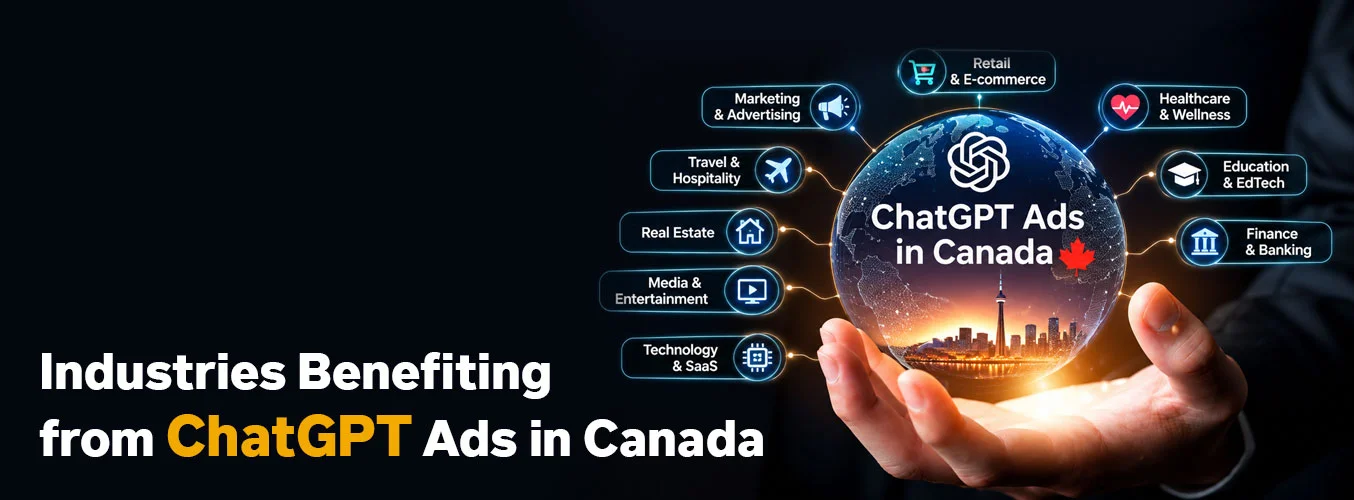
E-commerce, technology, education, and home and trade services are among the sectors well positioned for AI ad placements in Canada. These industries share a common pattern: buyers ask detailed, multi-part questions before committing to a provider.
AI-generated responses are well-suited to that kind of research behaviour. Any sector where trust and detailed information matter in the buying decision benefits from appearing inside a platform users already associate with reliable answers. Canada was among the first three countries to receive the rollout after the US. Most Canadian businesses have not yet run a single campaign here, which means the auction is less competitive now than it will be.
2. What Should You Expect When Working with a Specialist AI Advertising Agency?
Partnering with a ChatGPT advertising agency that Canadian businesses trust means starting with a thorough review of your goals, target audience, and what success looks like for your specific industry. From there, the agency builds your full campaign structure, develops multiple ad creative variations, handles technical allowlisting, and configures conversion tracking through OpenAI’s pixel and Conversions API.
Bidding is monitored and adjusted based on real performance data. Monthly reporting covers impressions, clicks, spend and click-through rate, with no inflated figures. The ongoing work is active refinement because campaigns that stay current with platform changes consistently outperform those that run unchanged.
3. How Does Local Market Context Affect Canadian AI Ad Campaign Performance?
ChatGPT Ads campaigns benefit from understanding how Canadian buyers phrase their questions inside AI search and what local trust signals resonate with them. Canadian users frequently include geographic qualifiers, provincial specifics and sometimes bilingual elements in their queries. An agency with genuine local market knowledge builds creative and bidding strategies that reflect these patterns, rather than applying a framework designed for a different market.
For instance, a professional services firm in Toronto may need very different ad messaging than one in Vancouver or Calgary. Local context shapes placement relevance directly and should not be treated as an afterthought.
The Technical Steps That Determine Whether Your ChatGPT Ads Campaign Actually Works
A well-built campaign structure gets you into the auction. The technical setup determines whether your ads are eligible to run and whether results can be tracked accurately from the start.
1. Why Is Allowlisting Your Website a Required First Step?
OpenAI’s crawlers must be able to access and validate your landing pages before your ads can run effectively. If your robots.txt file, server-side rules or firewall settings block those crawlers, your campaign reach is directly limited.
Want a done-for-you local SEO audit for your Toronto or Mississauga business?
Many businesses run campaigns without realizing this step is missing and agencies unfamiliar with AI ad infrastructure frequently make the same error. Configuring allowlisting typically involves adjusting your robots.txt file, server-side access rules and any web application firewall settings, including tools like Cloudflare. Skipping it means your landing pages cannot be fully indexed or validated, which reduces how competitively your ads perform inside the auction system.
2. How Does Conversion Tracking Work Inside OpenAI’s Ad Platform?
Knowing your ads are running is not the same as knowing what they produce for your business. OpenAI provides a Measurement Pixel and a Conversions API specifically for tracking the actions users take after clicking your ad. Properly configured, these tools record leads, purchases, sign-ups and enquiries, and that data feeds directly back into campaign optimization. This information informs bid adjustments and creative refinement over time.
Setting up tracking from the very first week ensures you have a clean data baseline. Without it, meaningful campaign optimization is significantly harder to achieve as results accumulate.
3. What Role Does Your Landing Page Play in Overall Campaign Performance?
A strong landing page is an active part of your campaign’s performance, not just a destination. OpenAI’s crawlers index and assess your landing pages as part of the ad eligibility and relevance process. Pages that load slowly, contain inconsistent messaging or fail to match the intent behind the ad can affect how your campaign is scored and served.
For instance, if your ad speaks to a specific service and the landing page opens on a general homepage, that disconnect reduces both relevance scores and conversion rates. Landing page quality is a campaign performance variable that deserves attention before launch.
What to Realistically Expect in the First 90 Days
Most businesses want the results immediately. The reality with any new ad channel is that the first weeks involve data collection. Understanding this timeline upfront prevents premature decisions that can disrupt a campaign before it gains traction.
1. When Does Meaningful Performance Data Start to Appear?
Initial campaign data typically becomes available within the first few weeks of launch. Clicks, impressions and spend data appear early, but meaningful optimization begins once enough conversion data has accumulated to identify clear patterns.
Most well-configured campaigns start showing clear and reliable performance trends within the first 60 days of running. At that stage, patterns in ad creative performance, bid competitiveness and audience intent become clear enough to guide targeted adjustments.
Treating the first two months as a calibration period, rather than expecting peak performance from day one, consistently produces far better results over the full campaign lifecycle.
2. How Should You Adjust Your Strategy as Performance Data Builds Up?
As conversion and click data accumulate, bid adjustments should reflect what the data shows rather than assumptions made before launch. Ad variations that perform well should be expanded; those that consistently underperform should be replaced with new creative directions.
Bid strategy can shift as the campaign develops. A campaign that starts on a cost-per-thousand model to build awareness may later move toward cost-per-click as conversion patterns become clearer.
The platform rewards campaigns that adapt based on real results rather than those running unchanged from initial setup. Regular monthly reviews are the practical mechanism for keeping performance moving forward.
3. What Does a Healthy Campaign Look Like After the First Quarter?
After 90 days of active management, a well run campaign typically shows consistent impression volume, a click-through rate that reflects genuine audience interest and conversion data linked to specific ad variations. Costs should be stable and predictable within the approved budget range. The creative library should have expanded based on what early testing revealed about audience preferences.
A healthy campaign at this stage is one that is refining and not rebuilding. The foundation should be solid enough that monthly work focuses on incremental improvement rather than correcting foundational problems. This steady refinement is what separates growing campaigns from stagnant ones.
The way people search for products and services is changing. ChatGPT Ads are one of the clearest signals of that shift, placing brands directly inside AI conversations at the exact moment buyers are forming decisions. For Canadian businesses willing to understand how this channel works and what it requires technically, the opportunity to gain early positioning is real. G Web Pro helps businesses build, manage, and refine campaigns that produce measurable results inside a platform most competitors have not yet entered. Getting in early, with the right foundation, is where OpenAI’s ad platform offers its clearest advantage.