
The 2026 FIFA World Cup will bring unprecedented attention to Canada. Millions of people will search for places to stay, activities, and services they can trust. These searches will occur before they arrive and while visitors are in host cities. Many will be answered by artificial intelligence instead of traditional search results.
This shift is changing how brands are discovered. Appearing in AI-generated answers now influences which businesses are seen and referenced during high-intent moments. AI search marketing strategies are no longer experimental. They affect your visibility at the exact point where decisions are made.
Keep reading to understand how AI-powered search marketing shapes your visibility during global events and what brands must do to appear in AI-generated answers throughout the 2026 FIFA World Cup.
Table of Content
Search behaviour during major global events no longer follows traditional patterns. People expect immediate, summarized answers that help them make decisions quickly, especially when travelling or planning around live events. AI-driven search platforms are shaping those expectations and influencing which brands are noticed first.
Let’s look at the changes that are reshaping brand visibility during the FIFA World Cup 2026.
Search behaviour is moving away from scrolling through links. AI systems now summarize information and present direct responses to questions. During the FIFA World Cup 2026, searches such as ‘best hotels near stadiums’ or ‘restaurants open late in Toronto’ will often produce AI-generated answers. These answers pull from multiple sources and present a short list of trusted options. Brands outside those responses lose visibility even if the website ranks well in traditional search results.
FIFA creates a surge of short-term, high-volume searches. AI systems react quickly to these spikes by prioritizing current, well-structured information. Businesses that publish clear and relevant content before the event are more likely to be included. Businesses that wait until the tournament begins often miss the window when AI models decide which sources are reliable for event-related questions.
Brand visibility in AI-generated answers matters because users often accept the first response they see. Many users do not click through to websites at all.
If an AI system names a brand as a recommendation, that mention alone influences decisions. This is especially true for visitors unfamiliar with Canadian cities, neighbourhoods, or local businesses.
AI-powered search marketing relies on signals beyond keywords. AI systems assess consistency, clarity, and topical relevance. Brands with a strong digital footprint across websites, directories, and trusted publications are easier for AI to interpret. Context matters because AI evaluates how well content answers specific questions related to FIFA travel, events, and local experiences.
Canadian businesses hold local knowledge that global competitors lack. AI systems favour content that explains locations, regulations, and local details accurately. This creates an opening for Canadian brands to become primary sources during the tournament, particularly for searches related to transportation, accommodation, dining, and entertainment.
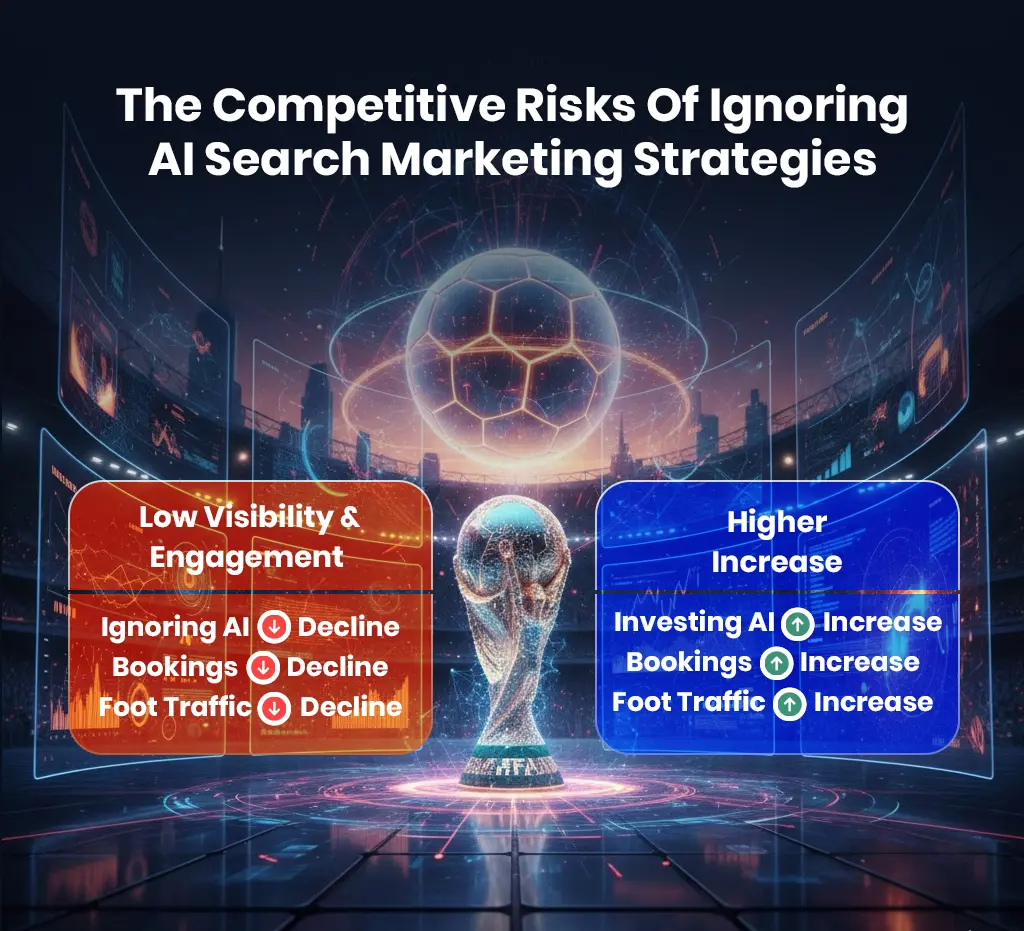
Ignoring AI search marketing strategies during the FIFA World Cup 2026 risks invisibility. Businesses may continue investing in traditional SEO while their competitors appear directly in AI responses. This gap affects bookings, foot traffic, and brand recognition at a time when demand peaks.
Understanding the shift toward AI-driven answers is only the first step. Brands that want to remain visible during FIFA 2026 need to translate that understanding into clear actions, supported by content structures and technical decisions that AI systems can interpret accurately. Preparation at this stage determines whether a brand is recognized as a reliable source during high-demand periods.
Here are the foundational elements that support AI search marketing strategies at FIFA scale:
AI-powered search does not read content the way people do. It looks for meaning rather than exact phrasing. Systems analyze topics, connections between ideas, and how clearly a brand answers specific questions. Content that explains who a brand serves, where services are available, and how that information relates to FIFA visitors is easier for AI to recognize and reference.
Once the meaning is clear, structure determines whether that content can be used. Structured content for AI helps systems extract information without confusion. Clear headings, direct answers, consistent terms, and well-defined service pages all support accurate interpretation. Content written with both people and AI in mind is more likely to appear in AI-generated answers.
Structure alone is not enough if the content does not match what people are looking for. Search intent during FIFA is often immediate and practical. People look for directions, availability, pricing, and local guidance. AI search marketing strategies should reflect those needs by answering real questions instead of pushing promotional messages. This alignment improves visibility during high-intent moments.
After the structure is in place, context becomes the deciding factor. AI systems recognize entities such as brands, locations, events, and services. Consistent content that connects these entities helps AI understand how a business fits into a larger picture. For example, a hotel clearly associated with a city, nearby stadiums, and transportation options becomes easier for AI systems to reference during FIFA-related searches.
Individual pages rarely provide enough information on their own. AI systems favour brands supported by multiple pages that reinforce their expertise and relevance. Articles, location pages, FAQs, and guides related to FIFA travel or local experiences work together to create a broader content ecosystem. This collective context helps AI systems identify reliable sources during periods of high search activity.
As content grows, how your website is organized becomes essential. Website architecture affects how easily AI systems access and interpret information. Clear page hierarchies, descriptive URLs, and consistent internal linking help AI follow relationships between pages.
When information is organized logically across a site, structured content for AI becomes easier to surface in AI-generated answers.
Planning and structure create the conditions for visibility, but results depend on execution. During the 2026 FIFA World Cup, brands must respond to real user needs in real time, using content and signals that AI systems can confidently reference. Success comes from applying strategy in a way that matches how AI-powered search works in practice.
Let’s break down the practical steps brands can take to appear in AI-generated answers during the tournament.
Brands can appear in AI-generated answers by addressing specific questions users ask during FIFA. Examples include ‘best transit options near venues’ or ‘trusted local services for visitors’. Clear and direct explanations increase the likelihood of selection by AI systems.
Structured content for AI supports accurate citation. When AI references a brand by name, it increases that brand’s credibility and recognition. Repeated citation across different AI responses strengthens brand presence without relying on clicks alone.
FIFA attracts international visitors unfamiliar with Canadian geography and services. Localized content written in clear language helps AI systems translate local knowledge into global answers. This approach supports AI-powered search marketing that reaches audiences before arrival and during the event.
AI-powered search marketing affects decisions made within minutes. A traveller asking an AI assistant for nearby dining options often chooses from the first response. Being present in that response influences spending and foot traffic immediately.
Measuring success requires new metrics. Brand mentions in AI-generated answers, citation frequency, and inclusion across multiple AI platforms matter more than rankings alone. These indicators reflect true visibility during the FIFA World Cup 2026.
The benefits of AI search marketing strategies extend beyond FIFA. Content created for the tournament continues to support visibility in future searches. Businesses that adapt early build long term relevance as AI search becomes standard.
FIFA World Cup 2026 represents a rare moment when global attention converges on Canada. AI search marketing strategies determine which brands are visible during that surge and which are overlooked. Businesses that understand AI-powered search marketing, invest in structured content for AI, and focus on brand visibility in AI-generated answers place themselves where decisions happen. Preparation requires clarity, relevance, and consistency long before the first match begins. This approach does more than support a single event. It establishes a foundation for future AI-driven discovery. G Web Pro works with businesses to plan and implement search strategies that reflect how AI systems actually operate, helping brands remain visible during the FIFA World Cup 2026 and well beyond.
AI search visibility refers to how often and how prominently a brand appears in responses generated by artificial intelligence tools, including those used in search engines. Instead of focusing only on where a website ranks, AI search measures how frequently a brand is named, discussed, or recommended in answers that users see directly from AI-powered systems. This matters because many users will rely on AI-generated answers during the FIFA World Cup 2026 for instant information about travel, local services, and events.
Traditional search ranks web pages in lists that users click through, but AI search generates direct responses to questions using summarized information. During large events, searches peak for venue details, schedules, and services, and AI models aim to provide quick, concise answers. This means a brand can be visible in an answer even if it does not appear at the top of a search results page. AI-generated answers depend on clarity of content, structured information, and contextual relationships rather than keyword ranking alone.
Yes. Structured content plays a central role in how AI models process information. Clear headings, well-organized topics, and consistent terminology help AI systems extract facts and citations accurately. When content is organized so that each portion can be understood independently, it becomes easier for AI to reference that information in answers. This type of content improves the likelihood that a brand will be included in responses to queries related to FIFA travel, local services, and visitor planning.
You do not need to discard traditional SEO, but you should expand your strategy. Classic SEO remains important for indexing and crawlability. However, visibility in AI-generated answers requires that content be structured and written in a way that AI systems can recognize as authoritative and relevant. This includes using clear language, topical depth, and entity connections such as linking brands to categories like location, services, and events. These signals help AI systems decide which brands to mention in answers.
Traditional metrics like ranking positions or click‑through rates are no longer enough. AI visibility is tracked by how often a brand is mentioned in AI responses across different platforms, the context of those mentions, and whether the content is cited correctly. Tools and tracking frameworks now exist that monitor brand mentions in AI overviews, AI-generated responses, and conversational search tools. These metrics give a clearer picture of how often AI systems reference your brand during high-demand periods such as the FIFA World Cup 2026.