
 Perplexity
 ChatGPT
 Claude
 Gemini
 Grok
Most Toronto-area businesses work hard on their website content. They plan topics, research keywords, and publish pieces on a schedule. But if the content, no matter how well made, does not match what people are searching for, it will not perform.
Search intent is the reason behind every search query. A person typing a how-to question wants to be educated. A person typing an agency name wants to hire someone. These two searches require completely different content.
When content misses the intent behind a search, it shows in the data that is generated. High bounce rates, low time on page, and flat lead numbers are all signs that something is off in your content strategy. The root cause is almost always a mismatch between what was written and what the reader needed.
Here we will discuss why content marketing strategies need search intent mapping to help build content that reaches the right reader at the right time.
What Professional Content Marketing Strategy Services Get Right That Most Businesses Miss
Understanding what your audience is looking for changes how you write, what you publish, and how well your content performs over time.
1. What Is Search Intent and Why Does It Matter?
Search intent is the goal behind a search query. It answers one question: what does this person really want when they type these words?
Google classifies intent into four types: informational, navigational, commercial, and transactional. Each one tells you where a reader sits in their decision process. Informational searches want to answer a question. Navigational searches want to find a specific page or brand they already know. Commercial searches want to compare products or services. Transactional searches signal readiness to act.
Understanding these four types is what makes content marketing strategy services so different from a content calendar that schedules topics without ever accounting for the intent behind each one. By not having intent clarity, even well-written content will attract the wrong audience and fail to drive results that matter to your business.
2. Why Do Most Content Plans Ignore Search Intent?
Most content plans begin with a keyword list and a publication schedule. A writer gets a topic and starts writing. The intent behind that keyword rarely gets examined. But choosing a keyword without understanding what the searcher wants is like sending the right person to the wrong address.
A blog post written to rank for a transactional keyword will frustrate someone who is ready to buy. A service page written for an informational keyword will push an early-stage reader away too soon. Intent-blind content tends to produce high bounce rates, which signals to search engines that the page is not serving the reader who found it.
3. How Does Search Intent Change the Keywords You Should Choose?
Not every keyword that looks relevant to your business is worth targeting. Intent is what determines its fit. A long-tail keyword like “what is content marketing” draws readers who are learning the basics of that topic. A keyword like “content marketing agency Toronto” draws readers who are actively shopping for help.
The same type of content targeted to both audiences will underperform for one or both groups. For instance, a buying-intent keyword placed inside a deeply educational post will bring in traffic that does not convert. Prioritizing keywords based on what the searcher intends to do next, not just relevance to your industry, is what builds a content plan that performs.

4. Why Does Content Format Have to Follow Search Intent?
Intent does not just shape what you write but how you write it. A searcher at the learning stage wants a blog post, a guide or an explainer. A searcher comparing options wants a comparison article, a breakdown or a case study. And a searcher ready to act wants a landing page or service page with a clear next step.
When the format does not match their intent, genuinely useful content falls short. The reader arrives, sees something that does not serve their immediate need and leaves before reading a word. Getting the format right is an intent decision and not a design choice.
How to Build Content Marketing Strategy Services Around Each Intent Type
Different intent types call for different formats, tones, and next steps for readers. Treating them all the same produces weaker results across the board.
1. How Should You Write Content for Informational Intent?
Informational intent comes from people who are learning, not buying. They want clear explanations, practical examples and useful detail without a sales angle. Well-run content strategy services address this stage with blog posts, guides, FAQs and how-to articles that answer the question at hand without pushing an offer. The goal here is not to close a deal but to earn trust by being genuinely helpful.
See What the Right Digital Marketing Strategy Could Do for Your Business
When a brand consistently answers informational questions well, readers begin to recognize it as a reliable source. That recognition is what brings them back when they are ready to buy.
2. What Does Good Content for Commercial Intent Look Like?
Commercial intent searches come from people who are actively comparing options. They want clarity, specificity, and evidence in these comparisons between products and services, not generalizations.
Comparison articles, service breakdowns, and case studies all serve commercial intent well. For instance, a business searching for the best content marketing agency in their area is not looking for a general explainer about marketing. They want to understand how different providers differ in their approach and results. Content built for commercial intent should name real differences, include honest details, and help the reader understand exactly what they would receive. Vague, promotional writing rarely satisfies this type of search and tends to push comparison-stage readers away.
3. How Do You Build Content for Transactional and Local Intent?
Transactional intent signals a readiness to act. These readers want a clear offer, a specific outcome, and a straightforward next step.
Service pages and landing pages built around transactional keywords should answer three things: what you offer, who it is for, and what happens next.
For businesses serving a specific region, local intent adds another layer to this process. A search like “content marketing Toronto” signals both readiness to hire and geographic specificity. Content that combines a strong offer with clear local relevance is what converts these searches into actual conversations with your business. Getting both the offer and the location signal right closes the gap between visits and leads.
4. Why Does Navigational Intent Still Deserve Attention?
Navigational searches happen when someone already knows your brand and wants to find a specific page. These are rarely the priority in a growth-focused content plan. However, they still matter for brand hygiene.
When service pages are hard to find, your brand name resolves to the wrong page, or your site structure is confusing, navigational traffic leaks before it can convert. Keeping your site well-organized and clearly labelled protects the traffic you have already earned. A clear site structure is a straightforward investment that keeps visitors from bouncing for the wrong reason before they ever reach the content you worked to create.
How to Know Your Content Marketing Strategy Is Working
Your analytics will tell you when intent mapping is working and when it is not. The signals are clear if you know what to look for.
1. What Do Bounce Rate and Time on Page Tell You About Intent?
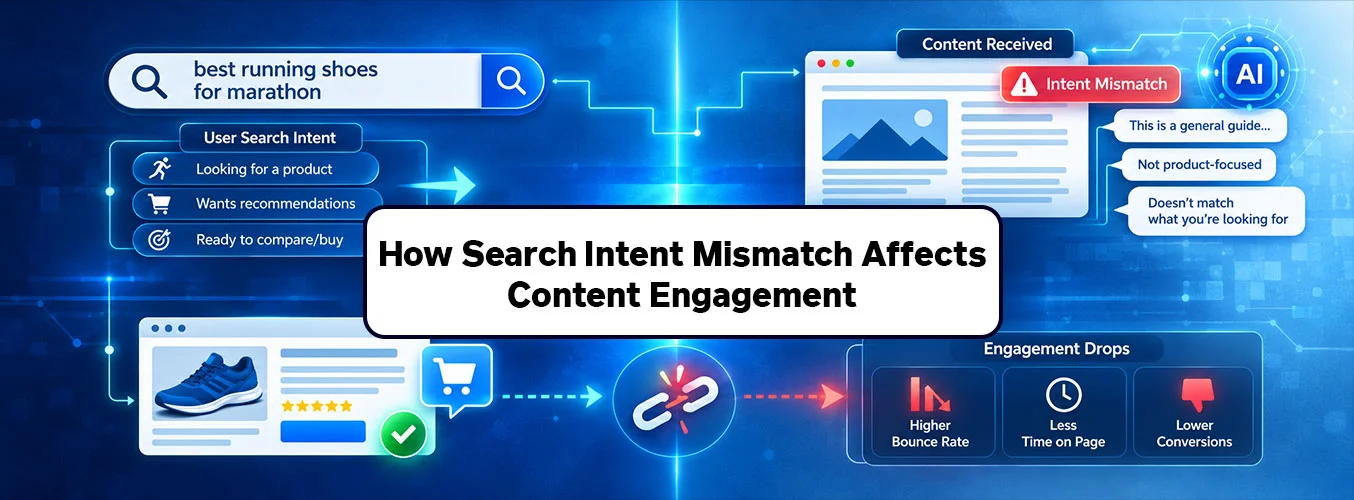
When a reader lands on a page and leaves within seconds, the content likely did not match what they were expecting. Bounce rate and time on page are the fastest indicators of an intent mismatch. A really high bounce rate on an informational blog post suggests that the page failed to answer the question clearly, or it attracted the wrong type of traffic altogether.
When your content marketing strategy is backed up by the right services and doing its job, time on page should be meaningful, and readers should be moving through the site rather than exiting after a single visit without taking any next step.
2. How Should You Track Keyword Rankings by Intent Type?
Ranking well for a keyword only helps if that keyword reflects the right intent at the right stage. Tracking rankings by intent type gives you a much clearer picture of where your content is actually working.
For instance, if you are ranking well for informational keywords but seeing no movement in commercial or transactional rankings, your content plan has a visible gap. Tracking intent-grouped rankings over time shows whether readers are moving through the decision process or arriving at the same early stage without converting into actual business inquiries.
3. Why Does Conversion Rate Tell You More Than Traffic Numbers?
Traffic is a surface metric. A post that drives a thousand visitors but generates zero leads is not a performance success. Conversion rate, tracked by content type and intent stage, tells you whether your content is moving people to act. Informational content should drive return visits or email signups. Commercial content should push readers toward a contact form or booking page. Transactional content should produce direct inquiries.
When conversion rates are low across all content types, the problem is usually intent misalignment, not writing quality. Fixing the strategy, not the prose, is what tends to turn those numbers around.
4. When Should You Review and Refine Your Intent Mapping Plan?
Intent mapping is not a one-time task. Search behaviour shifts. New keywords emerge, competition changes, and audiences grow more informed about what they are looking for. A well-run content plan builds in regular review cycles to examine what is working, what is slipping, and where new gaps are appearing. For instance, a keyword drawing informational traffic six months ago may now be attracting commercial searchers as that topic matures in your industry. Treating intent mapping as a living process rather than a setup task is what keeps your content relevant and your results consistent month over month.
Content that lands in front of the right reader, at the right moment, doing the right job is not an accident. It is the result of knowing what that reader wants before a single word is written. Search intent mapping turns a content plan from a publishing schedule into a system that works. If your current content is attracting traffic that does not convert, intent alignment is the right place to start. Professionals from an experienced digital marketing agency like G Web Pro build content marketing strategies based on real search behaviour, so every piece you publish earns its place.